
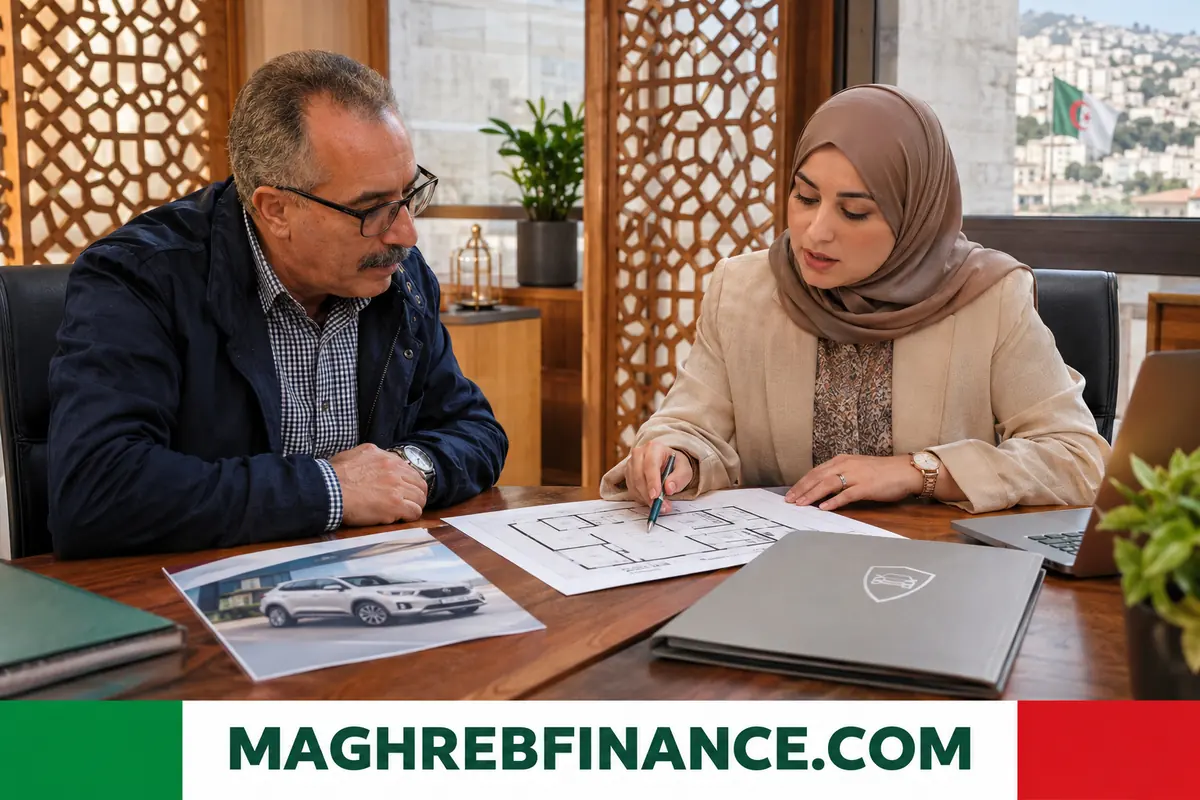
In Algeria, Ijara wa Iqtina is an Islamic vehicle and property leasing in which a bank buys an asset, makes it available to an individual against instalments, then transfers ownership at the end through a separate deed. The contract follows Sharia principles: no interest, real ownership of the asset by the bank during the period and shared risks. The client usually pays a contribution and monthly amounts, and the price is agreed in advance. It is offered by Islamic banks and participative finance windows, under the control of the Bank of Algeria.
What Ijara wa Iqtina means
The term combines two notions. Ijara refers to a lease, meaning the use of an asset for a payment. Iqtina means acquisition: the client commits, or receives a promise, to become owner at maturity.
Together they form a lease with a final transfer of ownership. The difference from a conventional finance lease lies in the religious rules: the lessor bears the risks linked to ownership, such as major defects or total loss, while the client is responsible for ordinary use and upkeep.
How the contract works step by step
The scheme follows a precise sequence.
- The client chooses the asset, a car or a home, and submits a request.
- The bank buys the asset from the seller and becomes its owner.
- An Ijara contract sets the payments, the duration and each party's obligations.
- The client pays and uses the asset.
- At maturity, a separate deed of sale or gift transfers ownership to the client.
The separation between the lease and the transfer is what makes the structure compliant, so the documents must never be merged into one vague agreement. A client who is unsure should ask the bank to explain in plain terms which document gives the right to use the asset and which one will later transfer ownership, and to hand over copies of both before signing anything.
Vehicle Ijara wa Iqtina
For a vehicle, the bank buys the car from an approved dealer, makes it available to the client and keeps ownership until the end of the contract. The client must maintain the vehicle, insure it and respect the agreed use.
Sharing of risks
The bank, as owner, bears the underlying risks, notably in case of total loss of the vehicle, while the client answers for upkeep and misuse. Ask exactly how a theft or an accident is handled and which insurer is named on the policy. Because the registration document may stay in the bank's name until the end, the client should also ask how fines, road tax and inspections are handled during the contract.
Property Ijara wa Iqtina
For a home, the bank buys the property, sometimes off plan, and makes it available to the client against payments. The amount depends on the price of the property, the term and the bank's margin. An initial contribution may be requested.
At the end, the transfer of ownership takes place before a notary. During the term the client lives in the home and may have to maintain it. Check who pays property-related charges, who insures the building and what happens if the client wishes to leave the home before maturity. A buyer of an off-plan home should also verify the delivery date, since payments may start before the keys are handed over and delays then weigh on the household budget.
Payments and total cost
The payments usually include a part corresponding to the repayment of the purchase price and a part that remunerates the bank. Some contracts provide for revision against a reference index, others a fixed amount.
Comparing without an interest rate
The client adds the contribution, all payments, deed costs, insurance and the final transfer price, then compares the total with the price of the asset. This is the only fair way to compare with a conventional credit, since the contract has no interest rate to read.
Conditions and documents in Algeria
The bank examines payment capacity: regular income, domiciled salary and debt ratio. The usual documents are an identity document, proof of residence, an employer's certificate, payslips, bank statements and proof relating to the chosen asset.
For property, the file also contains the seller's title deed or the developer's deed, and the bank verifies the legal situation of the property, including any mortgage or dispute. For a vehicle, the dealer's proforma invoice is required. The bank may ask for a guarantee in addition to the lease structure. Self-employed applicants provide tax declarations and activity documents instead of payslips, and the bank may ask for a longer history of account movements.
Strengths, limits and safeguards
The main strength is compliance with religious convictions, with a more visible sharing of risk. The client knows exactly what must be paid, and the contract distinguishes clearly between use and ownership.
The limits are the scarcity of the offer, the complexity of the contracts and sometimes a higher total cost than conventional credit. Read the clauses on termination and late payment carefully.
Governance and client protection
Each Islamic bank relies on a Sharia supervisory board that validates the contracts, and a national fatwa body for the Islamic financial industry provides a common framework. The client receives clear documents and may ask for explanations of each deed.
Frequently asked questions
How does it differ from murabaha?
Murabaha is a sale at a known margin with immediate transfer of ownership. Ijara wa Iqtina is a lease with transfer at the end.
Who owns the asset during the contract?
The bank. The client uses the asset and becomes owner only when the final deed is executed.
Is there a down payment?
Often a contribution is requested, especially for property. Its size depends on the bank and the asset.
What if the client cannot pay?
The contract sets the consequences. Contact the bank early to discuss rescheduling instead of waiting for default.
Can the contract be ended early?
Sometimes, under the conditions written in the agreement. Check the clause on early settlement before signing.