
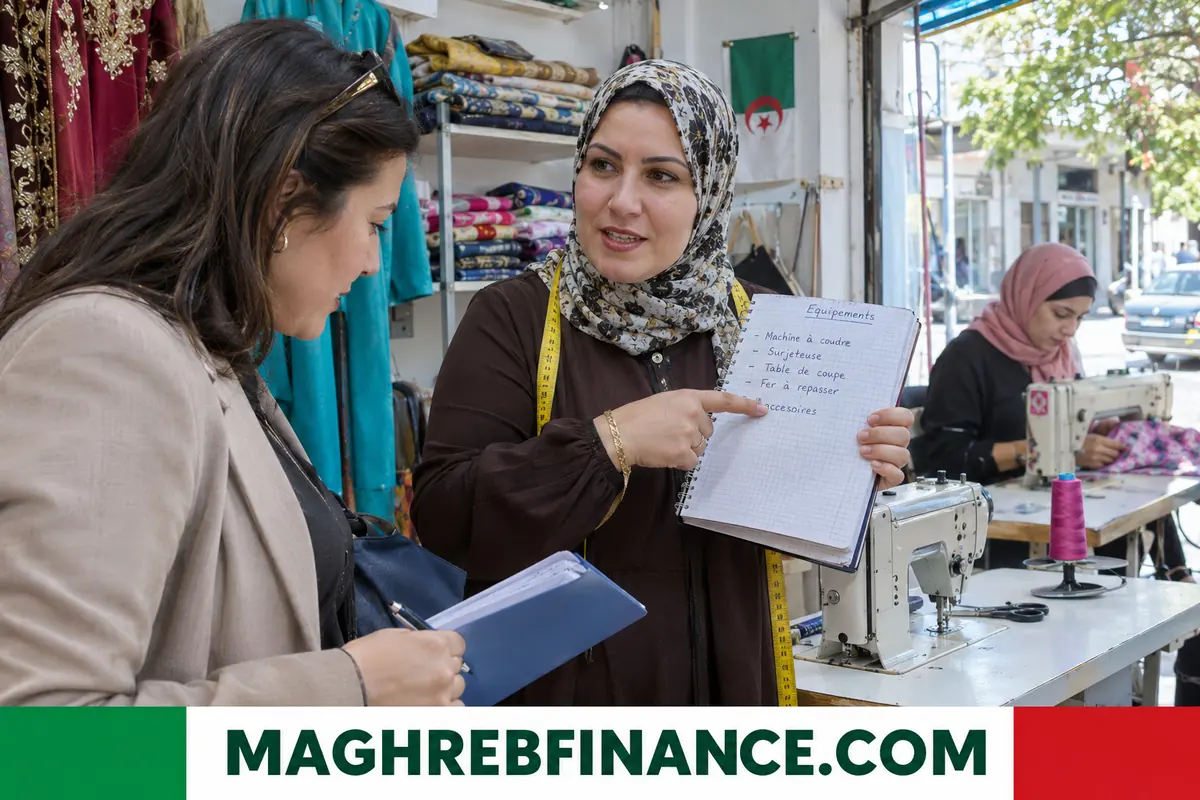
In Algeria, microcredit, microfinance and funding for small business projects let people with little capital start or expand a modest income-generating activity, from home baking and sewing to a market stall or a small workshop. Public agencies and partner banks lend in Algerian dinars (DZD), usually with lighter formalities than ordinary bank credit, and the aim is economic inclusion: the loan finances a project, not everyday consumption. It concerns unemployed people, craftspeople, rural families and young founders who need modest sums, advice and a realistic repayment plan.
What microcredit means in practice
A microcredit is a small loan repaid in monthly instalments that pays for an activity producing income. It differs from a standard bank loan through more flexible eligibility, guidance during the project and lighter paperwork. Typical borrowers have no stable salary and could not meet a bank's collateral requirements.
The purpose is productive: raw materials, small tools or a modest stock, rather than a holiday or a household appliance. That focus explains why agencies ask for a clear description of the activity.
Microfinance in the wider sense also includes small savings, guidance and, in some countries, insurance for borrowers. In Algeria the public scheme dominates the field, so information given by the local agency is the most reliable guide to the amounts, terms and documents that apply today.
Public schemes available in Algeria
The reference body is ANGEM, the national agency for microcredit management, which assists holders of small projects, works with partner banks and in some cases grants interest-free loans. Other public structures support business creation: ANADE, the national agency for entrepreneurship support and development, and CNAC, the unemployment insurance fund, which helps jobless founders who meet its criteria.
Credit guarantee funds for small and medium-sized enterprises can also reduce the collateral problem once a project grows.
Who can benefit
Target groups include job seekers, people without stable income, craftspeople, women working from home and residents of rural or isolated areas. Conditions generally relate to age, residence, lack of sufficient income and the nature of the project.
Usual requirements
- a minimum age and a personal situation matching the scheme;
- know-how or experience in the planned activity;
- a project that is realistic, lawful and viable;
- an identity document, proof of residence and a short description of the activity.
Each scheme publishes its own conditions, so applicants should confirm them at the local branch before preparing a file. A woman who bakes at home for local events, a young mechanic with experience but no workshop and a farmer who wants to add a small poultry unit would each follow a different route, even if all three look for a modest loan.
Activities that are commonly financed
Microcredit pays for raw materials, small equipment, production tools or supplies. Frequent sectors are crafts, tailoring, pastry, family farming, home services and small trade.
Examples of eligible spending
- a sewing machine or a professional oven;
- an initial stock of raw materials;
- carpentry, plumbing or mechanical tools;
- light equipment for a service activity.
A project that generates income quickly, such as food production for local shops, is usually easier to assess than one with a long delay before the first sale.
From idea to funding: the steps
Everything starts with an honest assessment of the market: who the customers are, what price they will pay and which equipment is needed. The file is then submitted to the agency, which checks the consistency of the project and, where the structure requires it, directs the applicant to a partner bank.
After approval, equipment is often bought directly from the supplier against an invoice, which limits the risk that the money is used for another purpose. Once the funds are released, repayment starts according to the schedule signed in the contract.
Training, follow-up and support
Funding is only one element. Beneficiaries may receive training in management, basic accounting and marketing, sometimes with vocational centres. Advisers help set prices, choose sales channels and begin on accessible markets.
A simple notebook that records daily sales, purchases and repayments is one of the best tools a micro-entrepreneur can have. It reveals problems early and reassures partner banks when the owner later applies for a larger loan.
Costs, repayment and risks
Public support can make loans cheaper, but repayment remains a real burden. Estimate income prudently, keep a cushion for slow months and avoid stacking several loans. A delay can trigger recovery procedures and damage access to later financing.
The most frequent mistakes are overestimating sales, forgetting fixed costs, buying oversized equipment and underestimating the start-up period. When the activity grows, the entrepreneur can move toward an investment loan, equipment leasing or an overdraft, helped by separate personal and business accounts. Other routes exist alongside the public schemes, such as ordinary bank credit for micro-enterprises, Islamic financing, family savings circles and support from cooperatives or associations.
Frequently asked questions
What is ANGEM in Algeria?
ANGEM is the national agency that manages microcredit. It supports small projects, works with partner banks and, in some cases, helps finance purchases through interest-free loans.
Who can apply for a microcredit in Algeria?
People without stable income, craftspeople, women working from home and residents of rural areas are common beneficiaries, subject to age, residence and project conditions set by each scheme.
What can a microcredit be used for?
It can pay for raw materials, small equipment and tools linked to an income-generating activity, but not for ordinary consumption such as holidays, furniture or household appliances. Agencies usually ask for an invoice or quotation to show that the money matches the stated project.
Is microcredit risk-free for the borrower?
No. Repayments continue even in slow months, and a delay can bring recovery procedures, so a cautious income estimate and a repayment cushion are essential. Borrowers should also keep every receipt and a copy of the signed contract.