
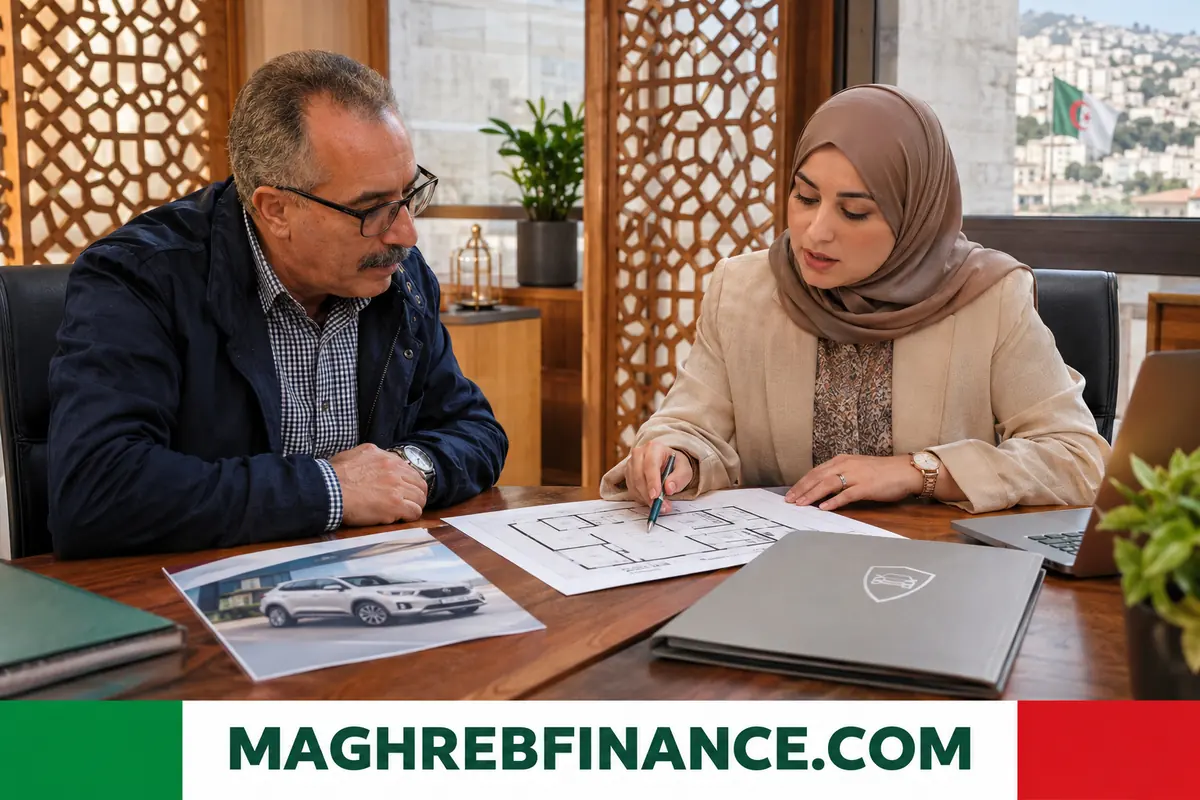
In Algeria, Islamic finance, including halal loans and takaful insurance, refers to banking and insurance products designed to respect sharia principles: no interest, shared risk and funding of lawful activities only. It serves individuals, professionals, farmers and companies seeking financing or cover without interest, and its range of products is still being built. Operations are conducted in Algerian dinars (DZD), and the Bank of Algeria supervises the institutions that sell these products, with a national religious conformity body reviewing them.
Principles behind sharia-compliant finance
The rules are simple: no interest (riba), no excessive uncertainty (gharar), no pure speculation and no funding of forbidden activities. The financier shares real risk and earns income from a sale, an agreed margin, a lease payment on equipment or a share of profit. A sharia board validates products.
Two common beliefs deserve correction. Islamic finance is open to any customer, not only practising believers. It is also not automatically cheaper, because margins and lease payments reflect refinancing costs and risk.
The Algerian framework
Algeria's Islamic banking began with a fully Islamic bank, Al Baraka Bank Algeria, and widened with Al Salam Bank Algeria. Later, public banks opened dedicated windows. A Bank of Algeria regulation lists permitted operations, and a conformity authority validates the products.
Insurers offer takaful solutions or specialised windows, clearly distinguished from conventional insurance. Islamic products therefore face double control: banking oversight by the central bank and religious review by the conformity body.
For the customer, this means that a halal label should be traceable to a named validation. Ask the branch for the document that records approval, and be wary of marketing that promises religious compliance without naming the body that granted it. Keep copies of every document received at signature.
Halal financing products
- Murabaha: the bank buys an asset such as a vehicle, equipment or goods and resells it with a margin known in advance, paid in instalments.
- Ijara: the Islamic counterpart of leasing, possibly with a purchase option.
- Musharaka and mudaraba: partnerships in which the bank and the client share profits and losses.
- Istisna'a: financing for manufacturing or construction.
- Salam: advance payment for goods delivered later, used mainly in agriculture.
Individuals mostly use murabaha for a car, equipment or property, while companies also use musharaka and ijara for investment.
Property and business financing
For housing, formulas close to instalment sale or lease-to-own allow a purchase without an interest-bearing loan. For professionals, ijara finances machines and utility vehicles, while musharaka suits projects where the bank takes a temporary stake. Collateral and down-payment requirements vary between institutions, so applicants should ask each bank for its conditions in writing.
A small manufacturer, for example, might use ijara for a machine, then musharaka when a larger order requires extra working capital. A farmer buying seed or equipment could look at salam or murabaha. In every case the asset, the price and the schedule should be written down before anything is signed, and the bank should explain who bears the risk if the asset is damaged or delayed.
Savings accounts and takaful
Islamic current accounts pay no interest. Investment accounts rely on mudaraba: the depositor entrusts funds to the bank, which invests them in lawful activities, and the return depends on results with no guaranteed gain. A saver should understand that capital is not always protected in the same way as a conventional passbook.
Takaful is based on mutual pooling. Participants pay contributions into a fund that compensates members who suffer a loss, while an operator manages it for an agreed fee. Possible surpluses may return to participants depending on the model.
Comparing a halal offer with a conventional loan
A halal financing is not automatically cheaper. Compare total cost, arrangement fees, collateral and early-settlement terms.
Questions for the bank
- Which body certifies that this product meets sharia rules?
- What is the total margin, expressed in dinars and not only as a percentage?
- What happens in case of late payment?
- Which fees come on top of the announced margin?
Ask for an information sheet showing margin, duration, total repayable and extra charges, and compare at least two institutions, including a conventional counter.
Islamic finance and financial inclusion
For households that stayed away from banks out of conviction, Islamic windows open access to accounts, cards and financing. This banking inclusion can channel savings into productive uses and help small businesses grow.
The industry remains a work in progress: rules evolve, the offer differs from one institution to another and some branch staff are less familiar with the products. Asking several banks for their conditions and reading the whole contract remain the best methods, particularly for first-time users who are comparing an Islamic offer with a familiar conventional loan.
Client rights and vigilance
The contract should state the financed asset, purchase price, margin, payment schedule and penalties. Clients are entitled to a signed copy, an explanation of the mechanism and a route for complaints. A product simply relabelled halal without an identifiable conformity body calls for caution.
Frequently asked questions
Is a halal loan free of cost in Algeria?
No. The bank earns a margin on a sale, a lease payment or a share of results, so the customer should compare total cost with that of a conventional loan.
Which banks offer Islamic finance in Algeria?
Fully Islamic banks exist, and several public banks have opened dedicated windows. The simplest way to compare is to consult their websites and branches.
What is takaful in Algeria?
It is insurance based on solidarity among participants, with a mutual fund and a paid manager, avoiding mechanisms considered contrary to sharia.
Is murabaha only for individuals?
No. Companies also use it to finance equipment or goods, while ijara and musharaka are common for investment projects.