
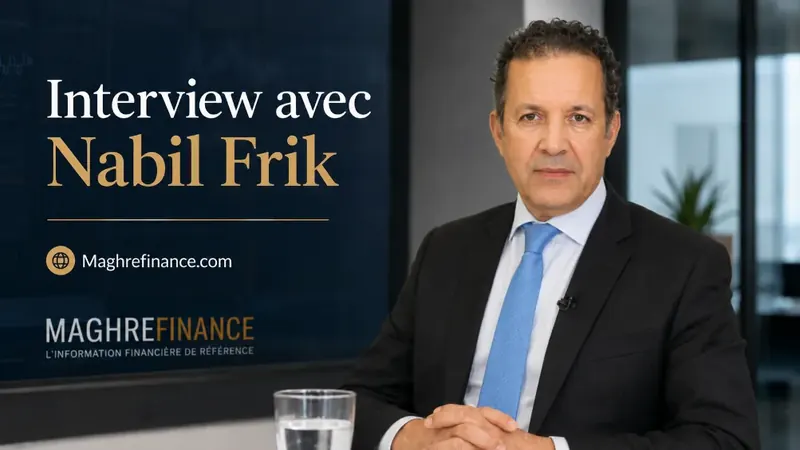
Maghreb trade finance expert Nabil Frik interview: twenty questions with an international banker on trade finance and economic development in Africa and the Middle East. Nabil Frik reviews the potential of the five Maghreb economies, from Algeria to Mauritania, the weakness of trade between neighbours, payments, documentary credit, bank guarantees, SMEs, energy, logistics, industrial value chains, foreign investment and FinTech, then sets out five priorities for closer regional integration. The conversation stays focused on economics, trade, investment and finance, and explains in plain terms what companies, banks and governments could do to turn scattered advantages into shared growth.
About the guest
“The Maghreb has the resources, the capital and the skills to become an indispensable economic partner”
Maghreb News talks to Nabil Frik, an international expert in banking, foreign trade finance and economic development in Africa and the Middle East.
With more than 25 years of experience in international banking, Nabil Frik has held several senior positions at leading financial institutions, including ING Barings, Europe Arab Bank, Bank of Beirut, Qatar National Bank and British Arab Commercial Bank (BACB) in London, where he was Managing Director and Head of Financial Institutions for Africa, the Middle East and Asia.
His career includes managing financial portfolios of more than one billion dollars, international trade finance, interbank relations, investment financing and the development of economic partnerships between Europe, Africa and Asia.
Now also involved in FinTech and in artificial intelligence applied to financial services, he brings a banking, entrepreneurial and international perspective to the Maghreb’s development opportunities.
In this interview, devoted exclusively to the economy, trade, investment and finance, he analyses how the economies of the five Maghreb countries — Algeria, Morocco, Tunisia, Libya and Mauritania — complement one another, and the conditions needed to turn this region into an economic market of global scale.
How do you assess the economic potential of the five Maghreb countries today?
The Maghreb is a particularly interesting economic area, but its collective potential remains largely untapped.
We are talking about five countries with close to 110 million inhabitants between them and a combined gross domestic product of around 587 billion dollars, according to the latest World Bank data.
What strikes me is how well their resources complement one another: hydrocarbons, minerals, agriculture, manufacturing, services, tourism, port infrastructure and human skills.
Individually, each of these countries has significant assets. Collectively, they could build a much more attractive market for international investors.
The real challenge is not simply to add up five economies, but to create extra value from the way they complement one another.
Why does trade between Maghreb countries remain so low?
It is probably one of the main economic contradictions of the region.
Maghreb countries have substantial trade relations with Europe and other international markets, yet trade among themselves remains very limited.
Analyses by the IMF and the African Development Bank put intraregional trade at less than 5% of the region’s total trade.
Several economic reasons may explain this: logistics costs, administrative procedures, differing standards, trade and banking restrictions, a lack of distribution networks and too few shared industrial chains.
Take a simple example: a Tunisian company can sometimes find it easier to sell certain products in Europe than in a neighbouring Maghreb market.
We should therefore start by identifying the concrete obstacles companies face and reduce them step by step.
A regional market is not built on agreements alone. It is built with customers, suppliers, hauliers and banks able to work together.
What are the main economic strengths of each of the five countries?
Each country has its own economic position.
Algeria has considerable energy resources, a large domestic market, financial capacity and scope for industrial, agricultural and mining development.
Morocco has a well-developed export-oriented industrial base, particularly in automotive, aerospace, phosphates, agri-food and logistics services.
Tunisia has recognised expertise in the electrical, mechanical, textile and pharmaceutical industries, as well as in IT services and engineering.
Libya has major oil resources and considerable potential in infrastructure, energy, construction and services.
Mauritania offers significant prospects in iron ore, fishing, energy, mining and economic links with West Africa.
The point would be to develop complementary projects rather than systematically trying to replicate the same industries in every country.
Could the Maghreb become an economic market comparable to some of the world’s major economies?
In terms of size, the Maghreb could certainly gain far greater international visibility by presenting itself as a more integrated economic area.
However, three things must be distinguished: the size of a market, its degree of integration and its competitiveness.
A group of nearly 110 million consumers is already an interesting commercial base. But that figure alone does not create a single market.
For investors, the key questions are these: can goods move easily? Are standards compatible? Can payments be made quickly? Are investments secure?
If progress is made on these conditions, the Maghreb could become an important industrial, energy, financial and logistics platform between Europe, Africa and international markets.
Economic power is not measured only by natural resources, but by the ability to produce, process, finance and export.
What role could Algeria play in this economic dynamic?
Algeria could play a major role thanks to a combination of factors: its energy resources, the size of its market, its infrastructure and its scope for industrialisation.
One opportunity would be to develop the local processing of natural resources further, notably in petrochemicals, fertilisers, metallurgy and industrial materials.
Energy could also make the country more attractive for regional manufacturing investment.
Algeria also has significant potential in food processing, pharmaceuticals, services and digital technologies.
To make the most of these strengths, partnerships between companies would need to be strengthened, suitable financing mechanisms developed and projects that create added value encouraged.
The economic aim should be to turn the available resources, step by step, into exportable industrial products.
What specific contribution could Morocco make to a more integrated Maghreb economy?
Morocco has valuable experience in developing industrial sectors aimed at international markets.
Automotive, aerospace, agri-food and port activities show the importance of productive investment, infrastructure and integration into global value chains.
In a regional context, this experience could encourage partnerships in industrial subcontracting, logistics, vocational training and skills transfer.
Imagine an industry in which some components are made in Tunisia, raw materials are processed in Algeria, assembly takes place in Morocco and part of the distribution is organised through several Maghreb ports.
This kind of industrial complementarity is what could boost regional competitiveness.
The point would not be to concentrate all production in one country, but to spread activities according to each one’s economic advantages.
Could Tunisia become a regional centre for services and industrial skills?
Tunisia has important strengths in human capital, engineering, technical training and business services.
It could help create Maghreb value chains in electronics, industrial components, software, medical equipment and financial services.
Developing regional centres for research, industrial design and digital services could also be a promising avenue.
It is important to understand that the added value of a modern economy does not lie solely in physical production.
Design, engineering, programming, maintenance and financial services are also major sources of income and skilled jobs.
Economic cooperation could thus offer Tunisian companies a wider regional market, while allowing the other countries to benefit from specialised skills.
What economic potential do you see for Libya?
Libya has considerable economic potential, notably thanks to its energy resources and its need for investment in infrastructure.
Construction, electricity, transport, telecommunications, health and services could offer significant business opportunities.
Companies from the other Maghreb countries could contribute to these projects under transparent, financially secured contracts.
We could imagine Algerian firms supplying certain building materials, Tunisian companies providing technical services, Moroccan manufacturers supplying equipment and Mauritanian companies taking part in some specialised supplies.
In this context, the role of banks and financial guarantees would be essential.
Investments should be structured with credible payment mechanisms, sound risk management and clearly defined contractual commitments.
Is Mauritania given enough weight in Maghreb economic prospects?
I consider Mauritania an essential part of the Maghreb’s economic future.
It has significant mineral, fishery and energy resources, as well as a particularly interesting geographical position between North Africa and West Africa.
Its potential is not limited to exporting raw materials.
There are opportunities in fish processing, port services, mining, logistics, irrigated agriculture and energy-related industries.
Gas projects and the prospects for developing renewable energy could also support industrialisation.
Mauritania could gradually become a trading platform linking the Maghreb economies with those of sub-Saharan Africa.
In my view, a complete Maghreb economic vision must fully include this African dimension.
Could energy be the first major area of economic cooperation between the five countries?
Energy is indeed a particularly promising area for cooperation.
The five countries have complementary resources or development possibilities: oil, natural gas, solar, wind and, in the longer term, low-emission hydrogen.
But we would need to go beyond trading energy raw materials.
Developing interconnected power grids, storage facilities, industrial equipment and specialised services could generate new economic activity.
The availability of competitive, reliable energy is also an essential factor in attracting industrial investors.
I see great potential in partnerships between energy producers, manufacturers, institutional investors and banks.
Even so, projects should be selected on their profitability, real needs and technological risks, rather than treating every energy investment as automatically profitable.
Are Maghreb banks sufficiently prepared to finance growth in regional trade?
Maghreb banks have significant expertise, but growing regional trade would require more effective financial mechanisms.
I have devoted a large part of my career to relations between financial institutions, international trade finance and cross-border banking operations.
In this field, companies need practical solutions: documentary credits, bank guarantees, import finance, export finance, standby letters of credit and risk-hedging mechanisms.
It would be worthwhile to develop interbank credit lines specifically for Maghreb trade transactions.
Banks could also set up agreements to confirm documentary credits and share risk.
It is not enough to encourage companies to trade with one another. They must be given the financial means to do so with confidence.
Should a Maghreb bank specialising in trade and investment finance be created?
The idea deserves serious consideration.
A regional institution could aim to support productive investment, shared infrastructure, exporting SMEs and trade between the five countries.
However, I would favour a pragmatic approach.
Before creating a new structure, we should look at the capacity of existing financial institutions and the scope for cooperation with the African Development Bank, Afreximbank and other international financial partners.
A first step could be to set up a joint trade guarantee and financing mechanism, in which willing public and private banks would take part.
This arrangement could then grow into a larger regional institution if business volumes justify it.
Its operation would have to rest firmly on professional banking criteria: independent governance, rigorous risk management, transparency and financial viability.
How can commercial payments between companies in the five countries be made easier?
Payments are a central issue.
Today, a transaction between two companies in different countries may involve correspondent banks and international currencies, which can increase costs and delays.
A gradual improvement could rest on three instruments.
First, strengthen correspondent banking relationships between Maghreb institutions.
Second, modernise payment systems and make them interoperable, subject to the applicable exchange regulations.
Third, study multilateral netting mechanisms that would settle the net balances of certain trade transactions.
The experience of African cross-border payment initiatives deserves to be examined.
I do not think a single currency is needed to get started.
The priority would be to allow an Algerian, Moroccan, Tunisian, Libyan or Mauritanian company to pay its regional supplier quickly, lawfully and at a competitive cost.
Could SMEs benefit more from a wider Maghreb market?
Small and medium-sized enterprises are probably the ones that could benefit most directly from better trade integration.
A large company may have enough resources to explore distant markets, open representative offices and negotiate international financing.
For an SME, these steps are often much harder.
A more accessible regional market could allow it to widen its customer base without immediately bearing the costs of global expansion.
In particular, I would propose developing regional programmes for bank guarantees, credit insurance, factoring and order financing.
A Tunisian SME making electrical components could then work with an Algerian or Moroccan manufacturer, with a suitable payment guarantee.
A Mauritanian seafood processing company could more easily reach distributors in several countries.
The key is to make regional integration a concrete economic advantage for entrepreneurs.
What shared industrial chains could be created in the Maghreb?
I see several particularly interesting possibilities.
The first is agri-business: agricultural production, food processing, packaging, cold storage and distribution.
The second covers construction materials, steel, fertilisers and petrochemicals.
The third is automotive, electrical components, mechanical engineering and industrial equipment.
A fourth sector could be pharmaceuticals and medical equipment.
Finally, digital technologies, data centres and financial services offer new prospects.
The economic logic should be to develop complementary specialisations.
A regional value chain can allow several companies to take part in making a single final product, which is then sold to Maghreb consumers or exported.
We should identify profitable pilot projects rather than try to create shared industries in every sector at once.
Could the Maghreb become a strategic logistics platform between Europe and sub-Saharan Africa?
Absolutely. Geography is one of the Maghreb’s main comparative advantages.
The region has a long Mediterranean coastline, an opening onto the Atlantic and overland routes to sub-Saharan Africa.
It also benefits from its proximity to the European market.
This potential could be realised by developing logistics corridors, port platforms, distribution centres and multimodal transport services.
But physical infrastructure is not enough.
We also need efficient customs procedures, electronic trade documents, clear transit rules and suitable banking services.
The time goods take to clear can matter as much as the distance they travel.
A high-performing economic corridor is one that reduces costs, delays and uncertainty alike.
The Maghreb could become a hub for processing and distributing goods between three major economic blocs: Europe, Africa and the Atlantic markets.
How could Maghreb countries attract more international investment?
International investors mainly look for profitability, regulatory predictability, skills, infrastructure and the security of their investments.
A more integrated regional market could make each of the five countries more attractive.
Take the example of an Asian manufacturer wishing to set up a presence in North Africa.
If that presence allowed it to supply several neighbouring markets with harmonised procedures, its investment could become more attractive.
It would be useful to develop regional industrial projects presented jointly to international investors, with a clear division of activities between the participating countries.
Public-private partnerships could also help finance some infrastructure, where risks are properly shared.
However, we must avoid confusing attractiveness with a proliferation of tax incentives.
A reliable regulatory environment, a skilled workforce and high-performing infrastructure can be far more lasting advantages.
What place could new technologies, FinTech and artificial intelligence have in this transformation?
Artificial intelligence and financial technologies can play an important role in modernising Maghreb economies.
These technologies are already improving financial analysis, risk assessment, document processing, payment management and access to information.
In international trade finance, for example, automation can reduce the manual work needed to check and process documents.
Digital platforms can also help SMEs compare financing solutions, find trading partners and access economic information.
I am particularly interested in these applications through my work in FinTech and in developing financing tools.
The Maghreb has significant human potential in IT, mathematics, engineering and digital services.
Partnerships between universities, banks, technology companies and investors could encourage the emergence of innovative financial solutions.
The aim should be to develop technologies suited to the real needs of local businesses, while protecting data and keeping human oversight of important decisions.
How could Maghreb countries become a heavyweight economic partner facing Europe, China, the United States and the Gulf states?
To become a major economic partner, the Maghreb would first need to strengthen its collective capacity to produce and export.
The world’s major economies look for partners able to supply reliable products, competitive services, energy, processed raw materials and commercial outlets.
The Maghreb could offer several of these advantages at once.
For Europe, it could be a nearby industrial and energy platform.
For China and other Asian economies, it could be a base for investment and for distribution to African and European markets.
For the Gulf states, it could offer partnership opportunities in industry, energy, agriculture, infrastructure and services.
The United States could also find opportunities in technology, industry, services and private investment.
But I want to stress one essential principle: international economic weight cannot be decreed, it is built through the competitiveness of companies, the quality of products and the ability to honour commercial commitments.
A more economically integrated Maghreb could negotiate larger-scale partnerships, while keeping the specialisations and international relationships of each of the five countries.
To conclude, what would be your five priorities for making the Maghreb a major economic power over the next ten years?
I would favour five concrete economic priorities.
First, make regional trade easier. Administrative obstacles should be reduced, some standards harmonised step by step and trade formalities simplified.
Second, modernise payments and financing. Banks should develop more trade finance mechanisms, guarantees and interbank cooperation.
Third, build shared industrial value chains. Companies could pool their capacities in energy, agri-business, pharmaceuticals, industrial materials and new technologies.
Fourth, improve economic infrastructure. Ports, logistics corridors, digital platforms and energy infrastructure should be developed according to their commercial viability.
Fifth, invest heavily in skills, SMEs and innovation. A competitive economy rests above all on its entrepreneurs, engineers, technicians, researchers and financial institutions.
I believe the Maghreb already has much of the resources it needs to develop.
Its main challenge is to turn these scattered advantages into productive projects, investment and trade that create jobs.
The aim is not to imagine a uniform economy, but to allow five different economies to become more complementary.
The Maghreb should not be seen merely as a set of five national markets. It can become a strategic economic area linking Europe, Africa and the rest of the world.
And I will close with this conviction: the Maghreb’s true wealth lies not only in its oil, gas, minerals or farmland, but in its ability to bring together the skills, capital and companies of its five countries around economic projects that create value.