
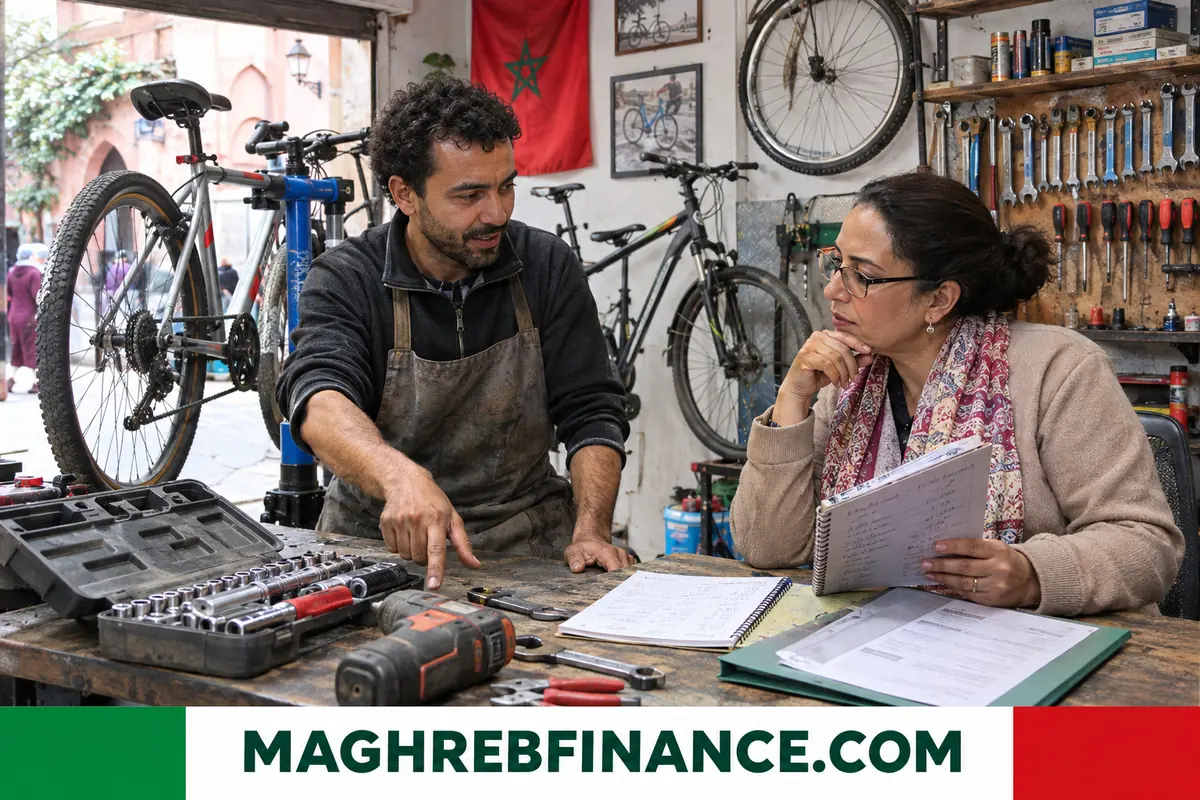
In Morocco, microcredit, microfinance and funding for small business projects provide modest loans in dirhams (MAD) to people who run or wish to start a small income-generating activity but lack the collateral or documents that banks usually require. Specialised associations, supported by a dedicated law and by public programmes, lend to street traders, craftspeople, farmers and home-based workers, often combining credit with advice, savings and insurance, and the loan is meant to finance a project rather than daily consumption. Rates and terms vary by provider.
What microfinance means in the Moroccan context
Microfinance associations lend small sums, usually repaid in short, regular instalments, to people excluded from classic banking. Loans are tied to a productive activity such as a stall, a workshop, a poultry unit or a tailoring business, and field officers visit clients to assess the project and follow repayment.
The sector is regulated by a specific law on microcredit associations, and Bank Al-Maghrib supervises its institutions together with other authorities. Beyond loans, many providers offer savings products, money transfers and insurance for borrowers.
Field presence is a strength: officers know local markets, which helps them judge whether a project can generate enough income to repay.
Main providers and programmes
Associations such as Al Amana Microfinance, Attawfiq Micro-Finance and Fondep reach urban and rural customers, and some are linked to banking groups or foundations. Agricultural credit is also distributed by Crédit Agricole du Maroc through its microfinance and rural lending activities.
Public programmes have supported young entrepreneurs and small businesses with favourable financing and guarantees. The national human development initiative, INDH, funds income-generating projects in disadvantaged areas, usually through local associations and cooperatives.
Women entrepreneurs and rural households form a large part of the clientele, and several providers design products for cooperatives and seasonal activities.
Types of loans offered
Typical products include solidarity loans for small groups, individual business loans, housing improvement loans and, with some providers, larger development loans or vehicle and property financing for established clients.
- A solidarity loan is granted to a group of two to five entrepreneurs who support one another.
- An individual business loan finances stock, equipment or an expansion.
- A housing loan funds repairs or a connection to water or electricity.
Amounts, terms and eligibility vary, so each provider's own leaflet is the reliable reference for current conditions.
Who qualifies and which documents are needed
Applicants are generally adults with a business activity or a credible project, a fixed residence and limited access to bank credit. The file is simpler than a bank file: identity document, proof of address, a description of the activity and, for groups, the commitment of every member.
Loan officers meet applicants at home or at their workplace, which helps people who cannot easily travel to a branch. The first loan is usually small, and amounts grow if repayments are on time.
A first-time borrower should expect questions about the household budget, existing debts and the experience gained in the activity.
Using the loan wisely
Funds should buy productive assets or stock that earn revenue within a short time. A seamstress might buy a machine and fabric, a farmer livestock feed or seed, and a grocer a refrigerator.
Keeping simple records of sales, costs and repayments shows whether the activity can bear the instalment. Separating household and business money, even in two envelopes, is a modest habit that prevents confusion.
Seasonal activities, such as selling at summer markets or processing argan products, may justify a repayment schedule that follows the sales calendar.
Guarantees and support for growing businesses
Microfinance usually relies on group solidarity, character references or modest pledges instead of property collateral. When a business grows, it may graduate to bank credit supported by guarantee mechanisms such as those run by Tamwilcom.
Training in management and marketing, offered by providers, chambers or associations, improves the chance of success. Business owners can also explore cooperatives to share equipment, buy inputs in bulk or access larger customers.
A simple cash-flow forecast written before the loan is signed makes it easier to discuss the amount and the term with the lender.
Costs, risks and warning signs
Check the annual cost, not just the monthly instalment: fees, insurance and the effect of repayment frequency all matter. Avoid borrowing from several providers at once, because overindebtedness is the main risk for small borrowers.
Unlicensed lenders who charge advance fees, hold identity documents as pledge or threaten borrowers should be refused. A legitimate provider issues a contract, gives a repayment table and accepts questions.
Ask what happens if an instalment is missed, and whether rescheduling is possible before penalties apply.
Alternatives and next steps
Depending on the profile, other routes include a classic bank loan for a micro-business, participative finance, rotating savings groups known as daret, family support or crowdfunding. Each has different costs and obligations.
Compare at least two providers, ask for the written conditions and keep every receipt. A realistic plan and a modest first loan are better than a large debt taken on enthusiasm.
Public advisory offices for entrepreneurs can help turn an idea into a short plan that supports any application.
Frequently asked questions
Who regulates microcredit in Morocco?
A specific law governs microcredit associations, and Bank Al-Maghrib supervises the sector together with other authorities. Consumer protection rules also apply to the information given to clients.
Which organisations provide microfinance in Morocco?
Al Amana Microfinance, Attawfiq Micro-Finance, Fondep and several other associations lend to small entrepreneurs, with rural lending also offered by Crédit Agricole du Maroc.
What can a microcredit be used for?
It can finance stock, equipment, a small expansion or housing improvements linked to the borrower's activity, rather than everyday consumption. Providers normally ask for evidence that the money has been used as planned.
Is a solidarity loan risky?
Group members support one another, but each member also depends on the others' repayments, so choose partners carefully and keep personal records. Group meetings also help members keep up with repayments.
What should I avoid when borrowing small sums?
Avoid unlicensed lenders, advance fees, several simultaneous loans and any contract you cannot read or obtain in writing.
Further reading
- Al Amana Microfinance : Moroccan microfinance association whose English pages list solidarity loans, individual business and housing loans, insurance and money transfer.