
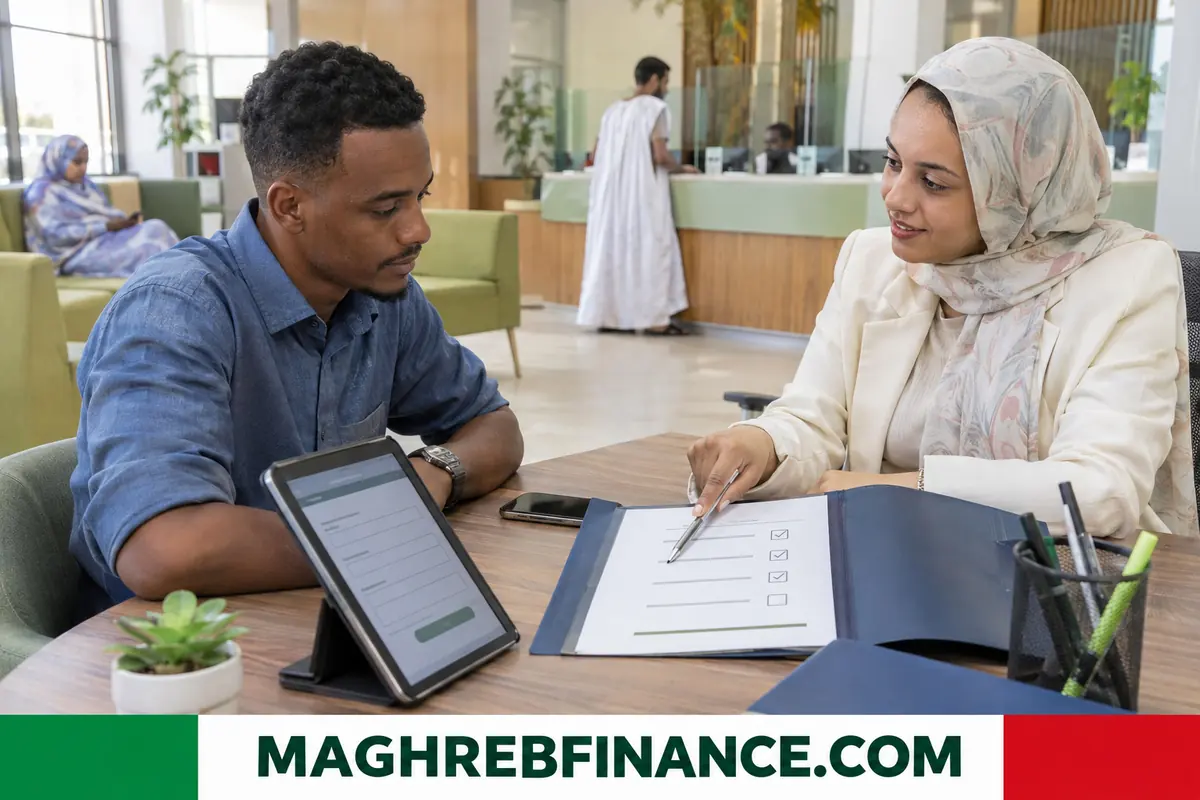
In Mauritania, banks and credit institutions provide corporate banking finance and personal services under the supervision of the Central Bank of Mauritania. They offer accounts in ouguiya and foreign currency, cards, loans, trade finance and mobile services to households, traders and companies. The sector mixes national banks, subsidiaries of foreign groups and Islamic institutions. Understanding each product, its cost and its conditions helps a customer choose financing that fits a budget and a project. Written tariffs and the licence of each lender are worth checking before any signature.
How the banking sector is organised
The sector includes commercial banks, Islamic banks and a few specialised financial institutions. The central bank grants licences, sets prudential rules and inspects lenders. Head offices are concentrated in Nouakchott, with branches in Nouadhibou, Rosso, Kaedi and Atar.
Distance to a branch remains a practical barrier in the interior, which explains the rapid growth of agents and mobile wallets.
Customers in the interior sometimes travel to regional towns for loans or large deposits, so asking about visiting days for credit officers or mobile agents can save a trip.
Branch hours, queues and the availability of cash machines differ markedly between a Nouakchott district and a small town, so test the service before moving a salary.
Main institutions
Banque Populaire de Mauritanie presents itself as a bank for individuals, professionals and companies, with financing, leasing, Islamic finance and mobile payment. Banque Nationale de Mauritanie is one of the country's long-standing banks. BAMIS, an Islamic bank in Nouakchott, offers digital services, cards, savings and financing.
Other banks with regional or foreign shareholders compete in corporate lending and trade services.
A Banque Populaire de Mauritanie example illustrates the trend: it advertises a financing simulator and the Bankily mobile payment service, which many customers use to move money without visiting a branch.
Accounts, cards and everyday services
A current account in ouguiya receives salaries and handles transfers and payments. Some banks also permit foreign currency accounts, useful for exporters and relatives abroad. Debit, credit and prepaid cards support withdrawals and purchases.
Remote banking
Mobile apps and online banking show balances, send money, pay bills and top up phone credit. Customers should use official applications only and never share confirmation codes.
Salary accounts are common for civil servants and employees of large firms, and employers may ask staff to open an account in a named bank, though customers may still compare tariffs and ask for a change.
Loans for individuals and professionals
Personal credit includes consumer loans, salary advances and equipment finance. Professionals obtain working capital loans, overdrafts, investment loans and bank guarantees.
The bank studies repayment capacity, collateral and account history. A borrower compares the total cost, including interest and fees, and asks about penalties for early repayment.
Overdraft facilities and salary advances are priced differently, so ask which is cheaper for a short need. Collateral may include a salary assignment, a vehicle pledge or a mortgage on property, and the contract should name each guarantee.
Applicants should prepare recent statements and a clear explanation of how the money will be used, because a precise purpose speeds the review.
Leasing and finance companies
A finance lease lets a business use equipment or a vehicle in return for rentals, with an option to buy at the end. Banque Populaire de Mauritanie states that it has run the country's only leasing activity for more than fifteen years.
Other finance companies work in narrow areas such as consumer credit, and customers should check their licence and supervision before signing.
Before signing a lease, compare the rentals with the purchase price, ask who insures the asset, and check what happens at the end of the contract and in case of early termination.
Foreign trade and currency operations
Banks help importers and exporters with transfers, documentary collections, letters of credit and guarantees. These operations follow exchange rules set by the central bank, which requires supporting documents.
- Domiciliation of foreign trade transactions.
- Transfers from relatives abroad.
- Financing of consumer goods imports.
- Guarantees for public contracts.
Importers should keep customs papers, supplier invoices and bank advices together, because the bank must justify each foreign currency payment to the central bank.
Customer rights and precautions
A customer should receive tariffs, a written contract and regular statements. Verify the institution's licence and refuse to pay an intermediary who promises a guaranteed loan against an advance payment.
In a dispute, write to the bank's complaints department first, then approach the supervisor. False credit offers on social networks are frequent.
Customers also have the right to close an account in writing, to receive a final statement and to challenge unauthorised card payments within the period stated in their contract.
Choosing a bank
Useful criteria are branch proximity, mobile service quality, account fees, support for businesses, an Islamic offer for those who want sharia-compliant financing and speed of processing.
Comparing two or three institutions through written conditions avoids unpleasant surprises and gives room to negotiate. Entrepreneurs gain from building a relationship with one adviser who knows their activity.
Ask whether the bank publishes tariffs on a notice board or website, and whether changes are announced in advance.
Frequently asked questions
Is a bank account needed to receive a salary?
It depends on the employer, but many companies and public bodies pay by transfer into a bank or mobile account.
Which documents open an account?
An identity document, proof of address and, for companies, registration papers and statutes, depending on the bank.
How can fake loan offers be avoided?
Verify the licence, refuse any payment before disbursement and contact the branch directly.
Do banks grant loans in foreign currency?
Some operations allow it, particularly foreign trade, within the exchange rules of the central bank.
What if there is a disagreement with the bank?
Send a written complaint, keep proof and, if needed, contact the supervisory authority.
List of banks in Mauritania
| Organisation | Type | Website |
|---|---|---|
| Banque Centrale de Mauritanie (BCM) | Central bank | bcm.mr |
| Banque Nationale de Mauritanie (BNM) | State-owned bank | — |
| Banque Populaire de Mauritanie (BPM) | Private bank | — |
| Générale de Banque de Mauritanie (GBM) | Private bank | — |
| Banque pour le Commerce et l'Industrie (BCI) | Private bank | — |
| Attijari Bank Mauritanie | Foreign-owned bank | — |
| BMCI Mauritanie | Foreign-owned bank | — |
| Chinguitty Bank | Participatory (Islamic) bank | — |
| BAMIS – Banque Al Wava Mauritanienne Islamique | Participatory (Islamic) bank | — |
| Banque Masrivi de Mauritanie | Private bank | — |
| Banque de l'Habitat de Mauritanie (BHM) | State-owned bank | — |
Non-exhaustive list; please check with each organisation.
Pages on the same theme
Individuals — Accounts and payments
- Mauritania current account checking account banking services
- Mauritania joint youth student accounts banking services
- Mauritania foreign currency account deposits withdrawals payments
- Mauritania diaspora nonresident bank account international services
- Mauritania debit cards domestic international purchases payments
- Mauritania credit cards deferred debit revolving reserve
- Mauritania prepaid virtual cards online shopping payments
- Mauritania electronic wallet mobile payment money transfers
- Mauritania instant bank transfers automatic direct debits
- Mauritania checkbook bank check issuance payment services
Individuals — Personal borrowing
- Mauritania conventional mortgage loan financing home purchase
- Mauritania subsidized approved mortgage loans home financing
- Mauritania land purchase loans house construction financing
- Mauritania property bridging loans home purchase resale
- Mauritania personal loan refinancing debt monthly repayments
- Mauritania unrestricted personal loans individual spending financing
- Mauritania earmarked consumer loans appliances renovation solar
- Mauritania car motorcycle loans private vehicle financing
- Mauritania education health wedding travel personal loans
- Mauritania authorized bank overdraft and salary advance
- Mauritania lombard loans savings securities collateral financing
Individuals — Leasing and rental
- Mauritania car leasing purchase option personal financing
- Mauritania inclusive long term car leasing services
- Mauritania motorcycle scooter electric mobility personal leasing
- Mauritania solar household equipment leasing individual financing
Businesses — Treasury and payments
- Mauritania business company accounts professional banking services
- Mauritania foreign currency business accounts importers exporters
- Mauritania electronic payment terminals ecommerce business solutions
- Mauritania business corporate banking cards company payments
- Mauritania corporate treasury investments deposits money funds
- Mauritania centralised treasury management corporate cash pooling
Businesses — Leasing and asset finance
- Mauritania conventional movable asset finance leasing businesses
- Mauritania vehicle fleet rentals leasing purchase options
- Mauritania leasing light commercial vans refrigerated trucks
- Mauritania heavy truck tractor unit trailer leasing
- Mauritania passenger transport bus minibus taxi leasing
- Mauritania construction machinery leasing excavators cranes bulldozers
- Mauritania agricultural equipment tractor irrigation system leasing
- Mauritania medical dental laboratory imaging equipment leasing
- Mauritania industrial equipment machine tools production leasing
- Mauritania computing equipment servers software telecommunications leasing
- Mauritania office furniture equipment leasing business finance
- Mauritania restaurant hotel bakery equipment leasing finance
- Mauritania renewable energy equipment generator leasing finance
- Mauritania boats fishing vessels maritime equipment leasing
- Mauritania property leasing offices factories warehouses clinics
- Mauritania movable assets property sale leaseback financing