
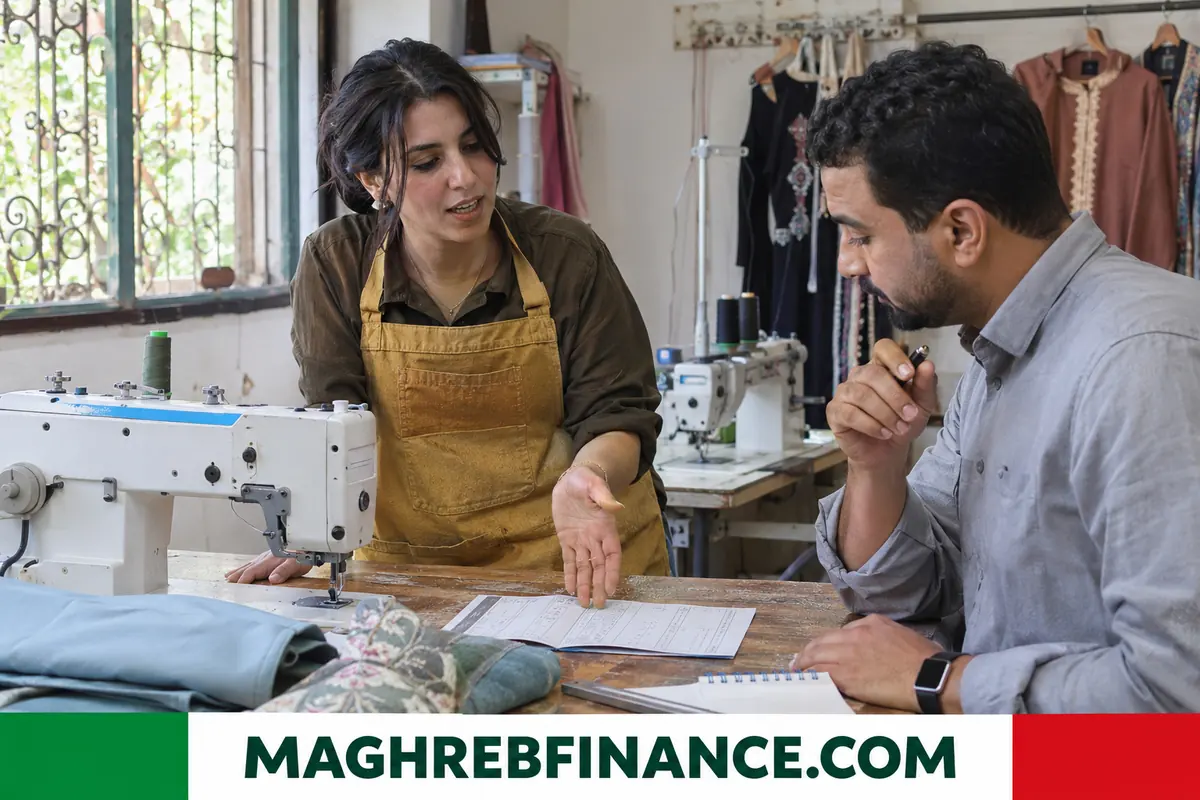
In Libya, microcredit and microfinance provide funding for small business projects that traditional banks hesitate to back. A craftsperson, shopkeeper, farmer or young graduate may obtain a modest sum to buy equipment or stock, or to start an activity. The sector remains underdeveloped and relies on public programmes, support funds, family networks and local initiatives, in a framework where the law prohibits interest and financing takes sharia-compliant forms. Planning a realistic project and comparing offers help avoid unnecessary debt. Seasonal income and uneven demand should always be taken into account in a repayment plan.
What microcredit means
Microcredit is a small loan for someone without access to ordinary banks, often because of limited collateral or irregular income. Microfinance is broader and covers credit, savings, insurance and guidance for low-income clients.
The goal is an income-generating activity such as a sewing workshop, a street kiosk, livestock, small-scale fishing or a repair shop. Beyond the money, training and follow-up decide success.
Examples help: a woman who bakes pastries at home may need a larger oven, a fisherman may need a net and an outboard engine, and a graduate may need a laptop and a printer to open a small copy shop.
The Libyan setting
Average income exceeds that of many neighbours, yet youth unemployment, liquidity limits and instability weigh on business creation. Long reliance on public jobs held back entrepreneurship.
Public institutions, support funds and international partners have launched schemes for small and medium firms, though coverage is patchy and results differ from region to region.
Families who receive money from relatives abroad sometimes use it as the first contribution to a business, which reduces the amount to be borrowed and improves the credibility of the application.
Regional differences are large, with better coverage in main cities and more limited access in the south, where distance and transport costs increase the price of every service.
Interest-free formulas
Under Libyan law, microfinance takes several shapes.
- Instalment sale: the institution buys the equipment and resells it with an announced margin paid in instalments.
- Partnership: the institution supplies part of the funds and shares results.
- Benevolent loan: only the capital is repaid.
- Grants and donations from foundations and public programmes.
A charitable loan is often offered by religious or community foundations and may come with a mentor, while an instalment sale usually involves a supplier chosen jointly with the institution.
Who can apply
Programmes often target young people, women, families displaced by conflict, jobless graduates and entrepreneurs in remote areas. Conditions vary: age, residence, absence of debts, a motivation letter and a costed project.
Papers to prepare
An identity document, proof of residence, a project description, an equipment quotation and, in some cases, a guarantor.
Applicants should keep copies of every paper submitted and obtain a receipt, because files can be lost when programmes change management or move to a different office.
Women applicants and young people under thirty sometimes qualify for special windows, so it pays to ask each programme about target groups before filling in the form.
Building a credible project
A good project answers four questions: who are the customers, what is the product, how much does the launch cost and what monthly income is expected. A one-page plan with realistic figures beats a long vague document.
Hidden costs such as transport, rent, power, permits and insurance must be included, and a cash reserve covers the first months, which are often slower than planned.
Customers matter too: a seamstress who already has orders from local shops can show a more reliable income than someone who only hopes to find buyers after opening.
Repaying without strain
Repayments must match the real income of the activity. A prudent rule is to keep instalments under one third of monthly margin. When trouble appears, warn the institution early rather than waiting for a missed payment.
Rescheduling is sometimes possible, while silence brings penalties. A simple notebook of daily takings and spending proves the activity's health.
If a seasonal activity such as farming or tourism drives income, ask for an instalment calendar with larger payments after the harvest or the busy season.
Seasonal workers and daily traders should leave a small buffer in their budget for illness, repairs or a sudden rise in raw material prices.
Risks and abuses
Informal lenders demanding hidden commissions, retention of documents or advance fees should raise alarm. Promises of guaranteed funding in return for upfront charges are a common fraud.
Before signing, read the contract, ask for the total cost, compare another offer and keep a copy of every document.
Checking the organisation
Ask for its registration details and confirm with the authority concerned.
Do not hand identity papers to a lender as security, and never accept a contract written in a language or format you cannot read.
Support and next steps
Incubators, business associations and training centres provide advice on management, accounting and marketing. An experienced mentor helps avoid early mistakes.
After a first loan repaid on time, an entrepreneur may qualify for larger amounts and standard banking services, which strengthens credibility. Networks of young entrepreneurs also share contacts and suppliers.
Alumni groups of vocational colleges and municipal job centres also pass on tips about open programmes, and they sometimes help applicants prepare their budgets.
Frequently asked questions
What is microfinance?
A set of financial services for low-income people, including small loans, savings, insurance and guidance.
Is Libyan microcredit interest-free?
The legal framework prohibits interest, so funding takes forms such as instalment sales or partnerships.
How much can be obtained?
It depends on the programme and project, with modest amounts suited to equipment or stock.
How is a scam avoided?
Refuse unofficial advance payments, verify the organisation and read the contract before signing.
Is a guarantor needed?
Often yes, or an equivalent guarantee, as set out by the organisation concerned.