
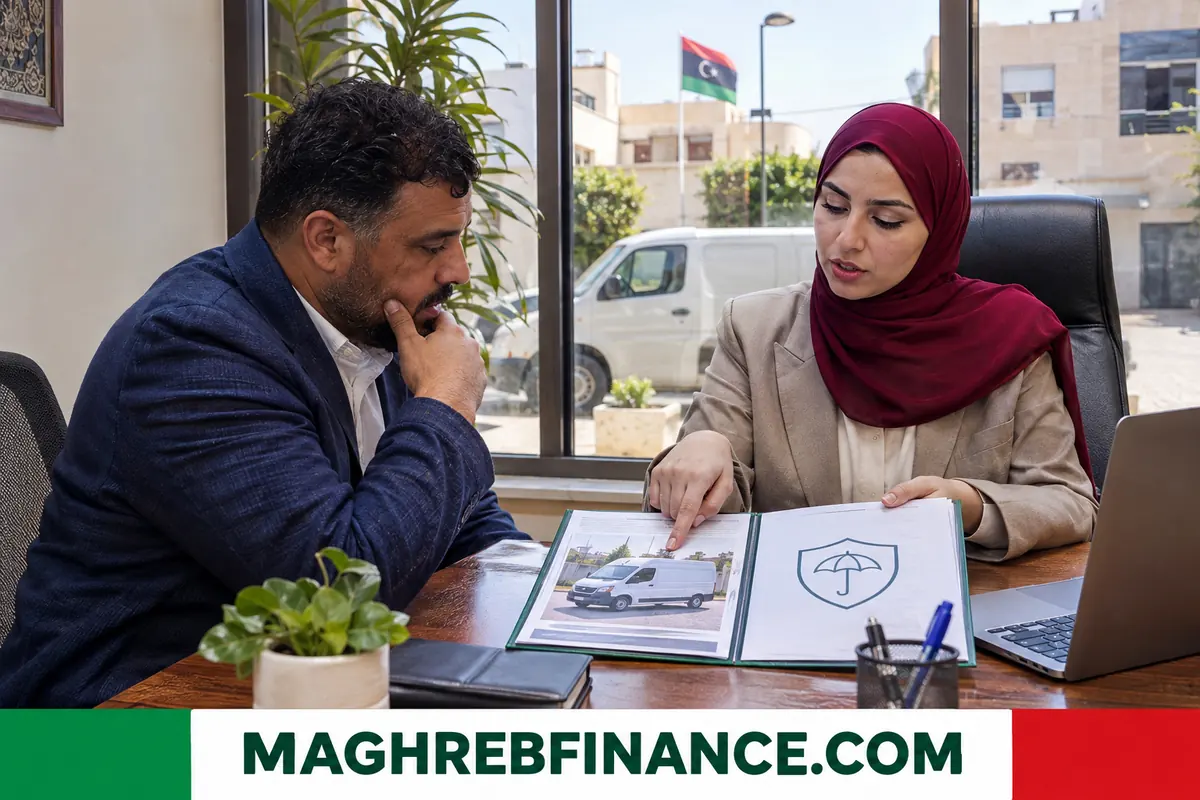
In Libya, murabaha is the cost-plus sale used for property, vehicle and equipment purchases, and it is the most common form of personal financing offered by banks that may not charge interest. The bank buys the item, discloses its cost and its profit margin, then sells it to the customer on deferred payment. Libyan dinar (LYD) contracts are supervised by the Central Bank of Libya, and each bank's sharia board approves the model. The customer therefore pays a fixed total price in instalments rather than interest on a loan.
Murabaha for property, vehicle and equipment: how it works
A murabaha contract has two steps. First the customer names the item and the supplier, and the bank agrees to buy it. Then the bank sells it on to the customer at cost plus a stated margin, payable in instalments.
The margin is written into the contract and does not rise if the customer pays late, which is the main difference from a conventional loan. Customers should ask for the total price in dinars, the number of instalments and the date each one falls due.
Branch staff usually prepare the sale documents themselves, so the customer signs a promise to buy, then the sale contract after the bank has taken delivery.
What can be financed
Banks in Libya mainly use murabaha for three categories of purchase.
- Vehicles, usually new cars from an agent or showroom with an invoice.
- Property, such as a flat, a house or a plot, where the seller can prove title.
- Equipment, for example workshop tools, generators, kitchen or medical devices bought by a self-employed person.
Each category has its own paperwork, and property deals take the longest because ownership has to be checked before the bank buys.
Second-hand items are harder to finance than new ones, because the bank needs a clear valuation and proof of ownership from the seller.
Eligibility and documents
Most banks look for a Libyan national number or a valid residence document, a salary certificate or proof of business income, and several months of account statements. A salary domiciled at the bank often speeds up approval.
Expect to provide a pro forma invoice from the seller, a copy of the item's papers and a guarantor or a salary transfer commitment. Requirements differ from one bank to another, so ask the branch for its written checklist.
Self-employed applicants should add a trade licence and, where available, tax or chamber of commerce documents that show regular activity.
Down payment, margin and total cost
Banks generally ask for an advance from the buyer, paid before the purchase, and keep the rest as the financed amount. A larger advance reduces the margin because the bank carries less of the price.
Compare offers by total price, not by monthly instalment alone. Ask about administration fees, insurance charged to the customer and the cost of registering a vehicle or property in the buyer's name.
Ask the bank to give the full repayment table before signing, with each instalment and the final balance shown line by line.
Ownership, guarantees and insurance
Until the last instalment, banks usually keep a guarantee on the asset. For a car this can be a registration restriction, and for property it is a mortgage-type charge recorded with the competent authority.
Vehicles must normally carry insurance, and the policy may name the bank as beneficiary. Make sure the cover matches the value of the item and remains valid for the whole repayment period.
Keep original title deeds or registration papers safe, and ask for their return in writing once the last payment is made.
Early settlement and late payment
Customers sometimes want to close the contract early. Some banks grant a rebate on the unearned part of the margin, while others do not, so this point should be agreed before signing.
Because the law forbids interest, a late payment cannot simply grow the debt. Banks may apply other remedies, such as seizing the guarantee or asking a court to enforce the contract, so contact the bank before an instalment is missed.
Checking the bank's complaint procedure in advance saves time if a dispute arises later on.
Risks specific to the Libyan context
Liquidity shortages, exchange-rate gaps and delays in importing goods can all affect a murabaha deal. If the supplier cannot deliver on time, the customer may wait while the contract remains open.
Read how the contract handles delivery delays, price changes and defects. Keep every invoice, receipt and signed page in a folder, and ask the branch to confirm in writing any promise made orally.
Avoid paying any part of the price directly to a supplier unless the bank has authorised it, since the sale must run through the bank to remain valid.
Alternatives to murabaha
Other sharia-compliant formulas exist, including ijara leasing, where the bank owns the asset and charges rent, and diminishing partnership for larger projects. They suit buyers who prefer a lease structure or who want to share ownership step by step.
Comparing two or three structures at the same bank helps customers see which has the lower total cost and the lighter obligations.
Frequently asked questions
Is murabaha the same as an interest-bearing loan?
No. The bank sells an asset at a disclosed price payable later, so the customer owes a fixed price rather than interest that accrues over time.
Can I choose the supplier myself?
Usually yes. The customer names the supplier and the item, but the bank must be the one that buys it and the invoice must be issued in the bank's name.
Does the bank add the margin if I pay early?
It depends on the bank and the contract. Some grant a partial rebate, others keep the full margin, so ask for the rule in writing.
Who complains if there is a dispute?
Start with the bank's complaints desk, then escalate to the Central Bank of Libya or the competent court if the problem is not solved.