
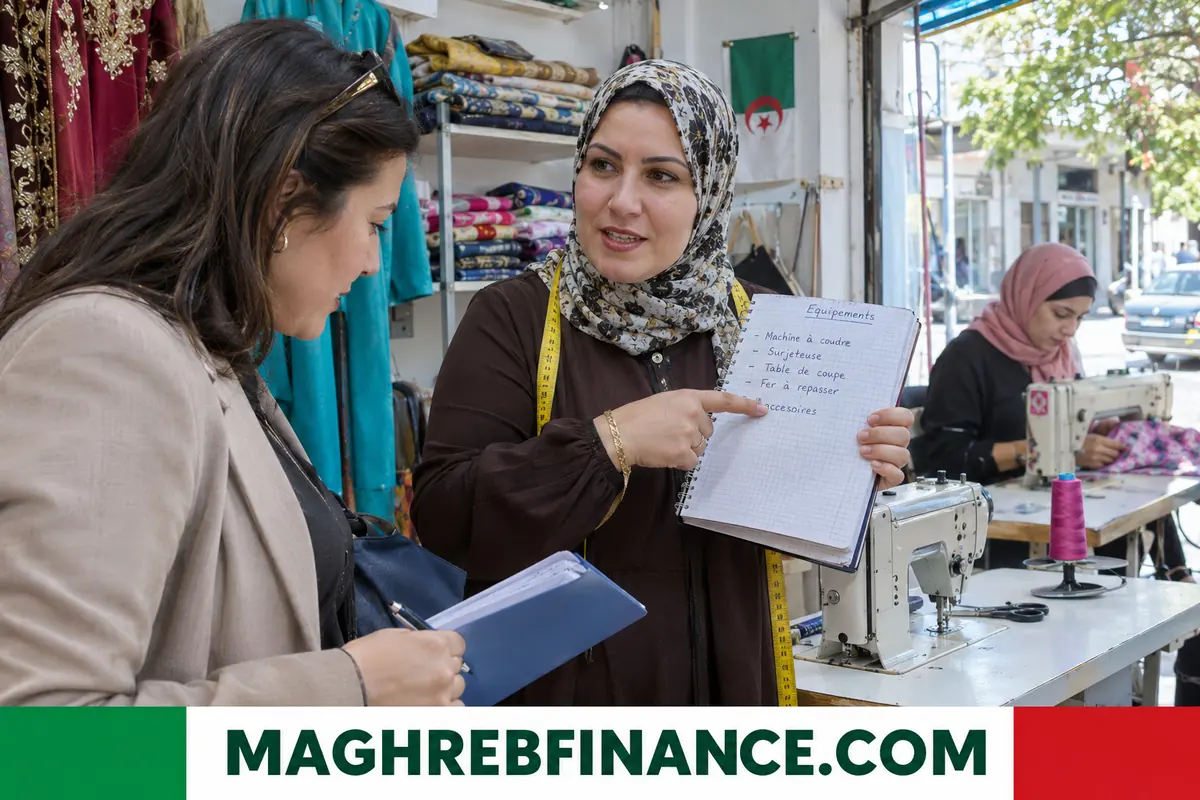
In Algeria, business microcredit and the honour loan, which public schemes call a non-remunerated loan, provide entrepreneur financing for people starting or developing a micro-business, on terms easier than ordinary bank credit and with support from dedicated advisers. They address young project owners, jobseekers, women working from home and craftspeople who receive limited sums, in Algerian dinars (DZD), often combined with a personal contribution and a subsidised bank loan, under the supervision of public agencies such as ANGEM and ANADE.
Who these schemes are for
The schemes target people with a viable idea but limited capital: a young graduate opening a design studio, a craftsperson buying tools, a woman starting a food business at home or an unemployed person creating a small workshop. Eligibility depends on age, status and the type of project, and rules are updated by the authorities.
They are not designed for large investments. Their purpose is to give small projects a start and to bring informal activities into the formal economy.
Business microcredit: a small loan to start
Microcredit finances modest amounts, for example the purchase of raw materials or small equipment. It is handled in Algeria mainly through the National Agency for the Management of Microcredit (ANGEM), which supports applicants, evaluates projects and, in some formulas, works with banks.
Repayment is spread over a term suited to the activity, and some formulas include subsidised interest. Applicants are expected to follow training, keep simple accounts and register their activity so that they gain access to later, larger financing.
Advisers also explain the repayment calendar, the insurance attached to the loan and the importance of keeping receipts for every purchase, since the agency may ask to see them during follow-up visits.
The honour loan or non-remunerated loan
A honour loan is an interest-free advance that complements the owner's contribution and the bank loan, giving the project a better capital structure. In Algeria, agencies such as ANADE, which supports entrepreneurship, and the unemployment insurance fund programme grant it as a non-remunerated loan under their rules.
The loan is repaid after a deferral, without interest. Its aim is to strengthen the promoter's own funds so the bank is more willing to lend. Conditions, ceilings and the sectors supported change with regulation, so confirm them with the agency.
Agencies and their roles
ANGEM deals with microcredit and small projects, including home-based activities. ANADE helps entrepreneurs and young start-ups with advice, training and financing formulas. The unemployment insurance fund scheme supports older jobseekers who want to create a business. Banks take part in some formulas by providing a loan alongside the agency's funds.
Visit the local branch of the relevant agency, bring the identity papers and the project idea and ask for the current list of eligible activities.
Building the application
The file typically includes a form, identity papers, proof of residence, a short project description, quotes for equipment, qualifications or training certificates and an estimate of costs and revenue. Agencies may ask for a business model and a realistic market study, even for a small project.
A convincing file explains who the customers are, how the product is sold, what it costs and when the first sales appear. Overstating revenue is a common weakness; reviewers know local markets and notice inflated figures quickly.
Applicants who attend the information sessions offered by the agency generally prepare better files, because advisers explain how the committee reads each document and which sections of the form deserve the most attention.
After funding: registration, accounts and follow-up
Once funds are released, the entrepreneur registers the activity, opens a bank account, buys the equipment and keeps invoices. Agencies visit to check that money was used as planned and to offer advice.
Regular repayment builds a record that allows access to bigger financing, such as an investment loan or leasing. Keeping a notebook of daily sales and costs, then a monthly summary, helps the owner see whether the business is really profitable.
What happens if the project struggles?
Contact the agency early. Rescheduling or advice is more likely when the problem is reported soon.
Mistakes to avoid, and how it differs from social microcredit
Frequent mistakes: borrowing for personal expenses, buying equipment that is too big, ignoring working capital and mixing household and business cash. Treat the loan as a project budget, not as extra income.
Business microcredit differs from social or family microcredit, which supports household needs, such as a repair or a purchase of consumer goods. Here, the money must produce income. Confusing the two products can lead to rejection of the request.
A practical example: a home-based pastry business
A woman in Constantine bakes traditional pastries for weddings and wants a larger oven, a mixer and packaging. She goes to the local ANGEM office with her identity papers, a list of equipment with quotes and a note on her customers.
The advisers help her calculate costs and expected sales, and after approval she receives funds to buy the equipment directly from the supplier. She repays in monthly instalments, uses a notebook to track orders and registers her activity.
Within two years she may qualify for a larger loan to lease a small workshop. The example shows how a first small financing can build a record.
Frequently asked questions
Is an honour loan really interest-free?
Yes, the non-remunerated loan carries no interest, but it must be repaid under the agency's rules.
Can I combine microcredit with a bank loan?
In some formulas, yes. The agency loan, the personal contribution and the bank loan are structured together.
Do I need a business already?
Not always. Many schemes support creation, though the activity usually needs to be registered when funds are released.
Where do I apply?
At the local branch of the relevant agency, after checking which scheme fits your age and project.
Can women apply?
Yes. There are formulas that encourage women, including home-based activities.