
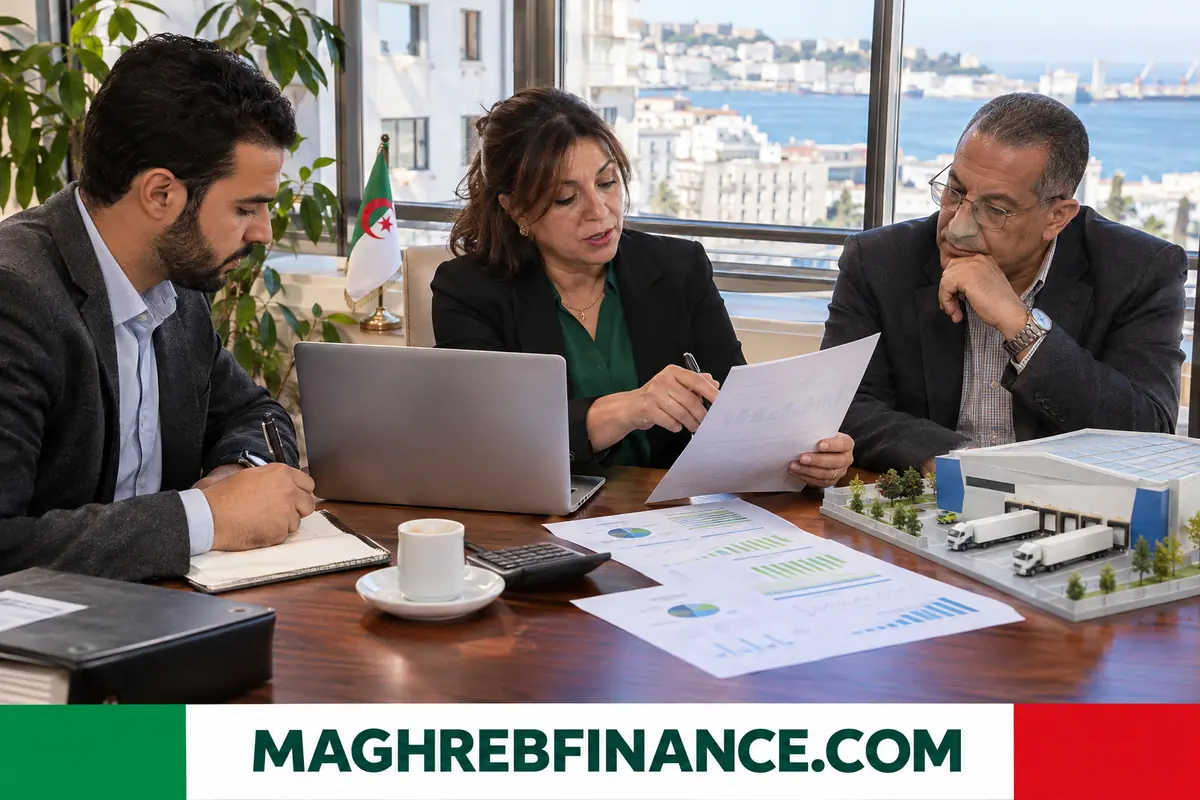
In Algeria, export prefinancing and the mobilisation of foreign trade receivables are two types of financing offered by banks to exporters: the first advances the funds needed for production before shipment, the second turns international trade receivables into cash before their payment date. They serve companies selling outside the country, especially beyond the hydrocarbon sector, whose production, shipping and payment cycle ties up working capital for several months. Both operate within Bank of Algeria foreign exchange rules and each bank's own policy.
Why exporting weighs on cash flow
An exporter must buy materials, produce, pack, transport and clear goods through customs, then wait for the foreign customer to pay, sometimes for several months. Meanwhile it carries wages and overheads. A firm winning a large order abroad may therefore need more working capital than it has ever used for the domestic market.
Bank financing bridges this gap and allows the company to accept orders it could not otherwise fund.
Smaller firms feel the strain most, since they have fewer credit lines and less bargaining power with banks, so understanding the available tools early gives them a real advantage when a first foreign order arrives.
Prefinancing: funding before shipment
Prefinancing is a short-term credit granted on the basis of a firm order or an export contract, to pay for raw materials, production and shipment preparation. The bank examines the quality of the order, the solvency of the foreign buyer, the producer's capacity and the expected margin.
Repayment normally comes from the proceeds of the export, so the bank often asks that payment be routed through it. A date-palm packer or a producer of canned goods may use it ahead of a seasonal order, for instance.
The bank may release funds in stages, linked to production milestones, and it often requires the export contract to be assigned to it, so that proceeds flow back to the loan.
Mobilising foreign trade receivables in Algeria
After shipment, the exporter holds a receivable on its customer, payable on a later date. Rather than wait, it can mobilise it: the bank advances part of the amount, minus interest and commissions, and collects the full sum at maturity.
- The advance is usually a percentage of the invoice value.
- The bank may keep recourse against the exporter if the buyer does not pay.
- Credit insurance on the receivable can improve the terms.
A producer of olive oil shipping to Europe, for example, can mobilise a ninety-day invoice immediately after loading and use the cash to buy the next harvest's packaging.
Public support for exporters
Several bodies support Algerian exporters. The foreign trade promotion agency ALGEX points firms to markets and trade fairs, and the export insurance and guarantee company CAGEX covers non-payment and political risks. Chambers of commerce and professional associations also give practical help with documents and contacts.
Combining such support with bank financing strengthens a file, because the lender sees a risk that is shared and monitored.
These services do not replace bank credit, but they reduce the lender's perceived risk and can lead to better terms or higher limits.
Exchange rules and repatriation of proceeds
Exporters must follow Bank of Algeria rules on bank domiciliation, repatriation of foreign currency proceeds within the periods set, and management of currency accounts. A part of the proceeds may, under conditions, be kept in a foreign currency account.
Breaching these rules can result in penalties and block future operations, so the finance team should keep a calendar of due dates and supporting documents.
Currency accounts allow the exporter to pay foreign suppliers directly in the currency earned, which lowers conversion costs and exchange exposure.
Building the file in Algeria
The file includes statutes, recent accounts, the commercial register, the contract or order, the product's technical sheet, the cost price calculation, the production plan and information on the buyer. A realistic cash plan showing when funds are needed and when they come back is particularly useful.
Many exporters also attach market studies, references from earlier shipments and certificates for quality or origin, which show that the order is credible and can be executed on time.
The more precise the cost calculation, the easier it is for the bank to size the credit, and the less likely it is that the exporter will run short before shipment.
Risks and advice
The main risks are late payment, quality disputes, exchange rate changes and transport or customs difficulties. A prudent exporter diversifies customers, insures receivables, negotiates clear payment terms and agrees on documents that match the contract.
- Check the buyer's solvency before accepting the order.
- Match the currency of the sale with that of the financing where possible.
- Keep proof of shipment and delivery.
Cost of financing and choice of bank
The cost of prefinancing or receivable mobilisation includes interest, commitment fees, file charges and, where relevant, the cost of insurance and guarantees. The exporter compares these elements and the bank's practice in handling documents, speed of payment and knowledge of the target market.
Choosing a partner bank
A bank with correspondents in the buyer's country, a specialised foreign trade team and an effective currency desk saves time. Ask for a written statement of all charges before choosing, and check whether the bank can also issue guarantees or confirm credits.
Frequently asked questions
What is the difference between prefinancing and receivable mobilisation?
Prefinancing provides funds before shipment to produce the goods, whereas receivable mobilisation advances cash after shipment against an invoice payable later.
Do exporters need a firm order?
Yes, banks generally base prefinancing on a firm order or contract, and assess the buyer's solvency and the producer's ability to deliver.
Which bodies help Algerian exporters?
ALGEX supports market access and promotion, while CAGEX offers export credit insurance and guarantees, alongside banks and chambers of commerce.
Must export proceeds be repatriated?
Yes. Bank of Algeria rules require proceeds to be repatriated within set periods through a domiciled bank account.
Can a small exporter obtain prefinancing?
Yes, if the order is firm and the bank is satisfied with the company's finances and ability to deliver. A smaller firm may need additional security.
Further reading
- Arab Bank Algeria : English-language site of Arab Bank in Algeria, presenting corporate banking and trade finance services for businesses.