
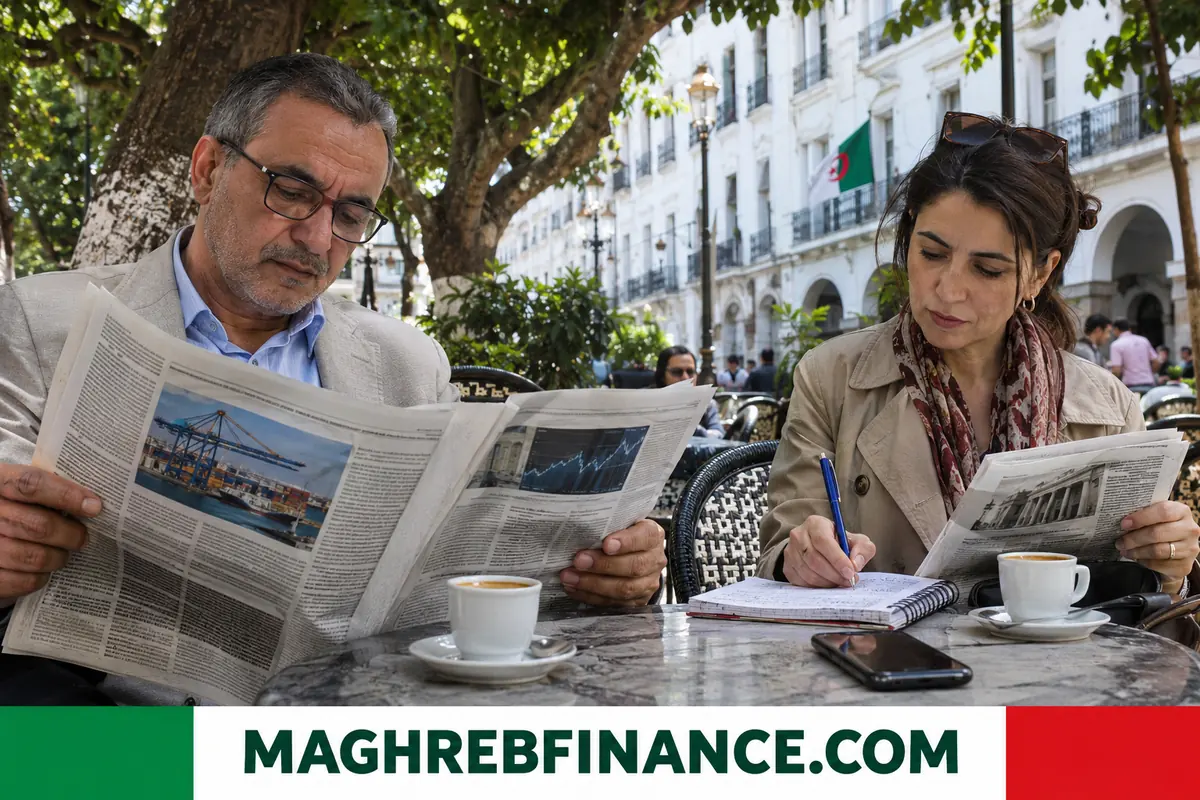
In Algeria, specialist banking, finance and insurance journals and publications filter, explain and put into perspective the information produced by banks, insurers, the stock exchange and supervisors. They include official reports and bulletins, academic reviews, economic media with banking and insurance sections, and professional newsletters. Bank officers, insurers, lawyers, accountants, entrepreneurs and students read them to follow rules, statistics and market trends expressed in Algerian dinars (DZD), while returning to the original sources whenever a number will support a real decision.
A sector that produces plenty of information
The Algerian financial system includes public and private banks, financial institutions, insurance companies, a stock market and supervisory bodies. Each produces information: annual reports, economic notes, circulars, statistics and press releases.
Specialist publications filter, explain and put this output into perspective. They address bank executives, insurers, lawyers, accountants and business leaders who need reliable and regular information.
Because the sector is regulated, a missed circular or a misunderstood rule can have real consequences, which is why professionals follow specialised titles closely rather than relying on general news alone.
Families of publications
Several categories exist side by side.
- Reports and bulletins from institutions: monetary and financial situation, financial stability and insurance statistics.
- Academic reviews in economics, management and finance, published by universities or research centres.
- Magazines and economic news sites with banking and insurance sections, such as Maghreb Emergent.
- Professional newsletters and economic notes from banks and firms.
- Practical guides for customers, published by institutions.
Each family has its own level of detail, frequency and degree of independence.
Banking in the publications
Recurring banking subjects are monetary policy, rates, reforms of the regulatory framework, digitalisation, payment methods, Islamic finance, small business financing and financial inclusion.
What one finds
Figures on credit to the economy, deposits, the share of the population with bank accounts and the number of branches and cards. Analyses of the governance of public banks and the arrival of private players. Files on electronic payments and mobile services.
How readers use them
A banker uses them to follow competitors, a student to find definitions and a firm to understand the conditions of financing.
Special issues devoted to a reform, such as a new payment instrument or a revised prudential rule, often give timelines, examples and the views of practitioners.
Insurance and finance in the publications
For insurance, publications track companies' turnover, the share of branches such as motor, property damage or life, regulatory developments and innovations, notably Takaful insurance and bancassurance.
For market finance, they cover securities issues, the activity of the Algiers Stock Exchange, listings, investment funds, corporate financing strategies and the role of private equity.
Analyses of the sector's weight in the economy help to understand why reforms matter for households and companies.
Interviews with heads of insurance companies or banks also show how institutions explain their strategy, which readers can compare with the figures that appear later in annual reports.
Official sources and how to use them
Reference data come from public institutions. A serious reader goes back to these sources rather than relying on a media summary. He or she consults the annual reports of the Bank of Algeria, statistics published by the insurance supervisory bodies, texts published in the Official Journal and company reports.
Why this approach
A summary can distort a figure, omit a period or confuse two concepts. The original contains the definitions, methods and limits that make the figure meaningful.
Choosing and following the right publications
For a professional, the selection criteria are reliability, regularity, depth of analysis and independence. A publication that gives its sources, corrects its mistakes and distinguishes information from opinion deserves trust.
A subscription to a few well-chosen titles is worth more than a scattered collection. One can combine a general economic title, a sector newsletter, an academic review and institutional reports. Students benefit from university libraries and public archives.
Copyright, quotations and ethics
Publications are protected by copyright. A short quotation with its source is accepted in personal or professional work. Full reproduction requires permission. Official figures are generally reusable with mention of the source, subject to licence conditions.
Ethics require avoiding confusion, not distorting statements and correcting one's own mistakes. In the financial sector, caution is necessary: a sentence taken out of context can change the meaning of an analysis.
Good practice for students and professionals
A student preparing a dissertation starts with the reference texts, then reads the analyses, before confronting viewpoints. He or she notes definitions and builds a glossary. A professional uses publications to feed internal notes, prepare credit committees or follow a competitor.
To avoid overload, set a weekly time budget, prioritise topics linked to the mission and archive documents by theme. A monitoring tool or a simple table helps to record what was read, when and why.
A short written summary of each important document, with its date and source, is more useful a year later than a stack of unread files.
Frequently asked questions
Which publications are best for official banking statistics?
The reports and bulletins of the Bank of Algeria and of the insurance supervisory bodies are the reference. Media articles can help interpretation but should not replace the original tables.
Can a student quote these publications in a dissertation?
Yes, with precise references: author, title, date and source. Short quotations are accepted. Copying long passages without permission or mention is not.
Are economic news sites reliable for banking news?
Many are useful, especially for speed, but quality varies. Compare an article with the official notice or the institution's statement before relying on a figure.
How often should a professional read these sources?
Weekly is enough for most. A short routine, with one general title, one sector newsletter and the official reports as they appear, avoids overload while keeping knowledge current.
Further reading
- Algeria Press Service (APS) : Algeria's public news agency, with an English edition covering national news, the economy and world affairs.