
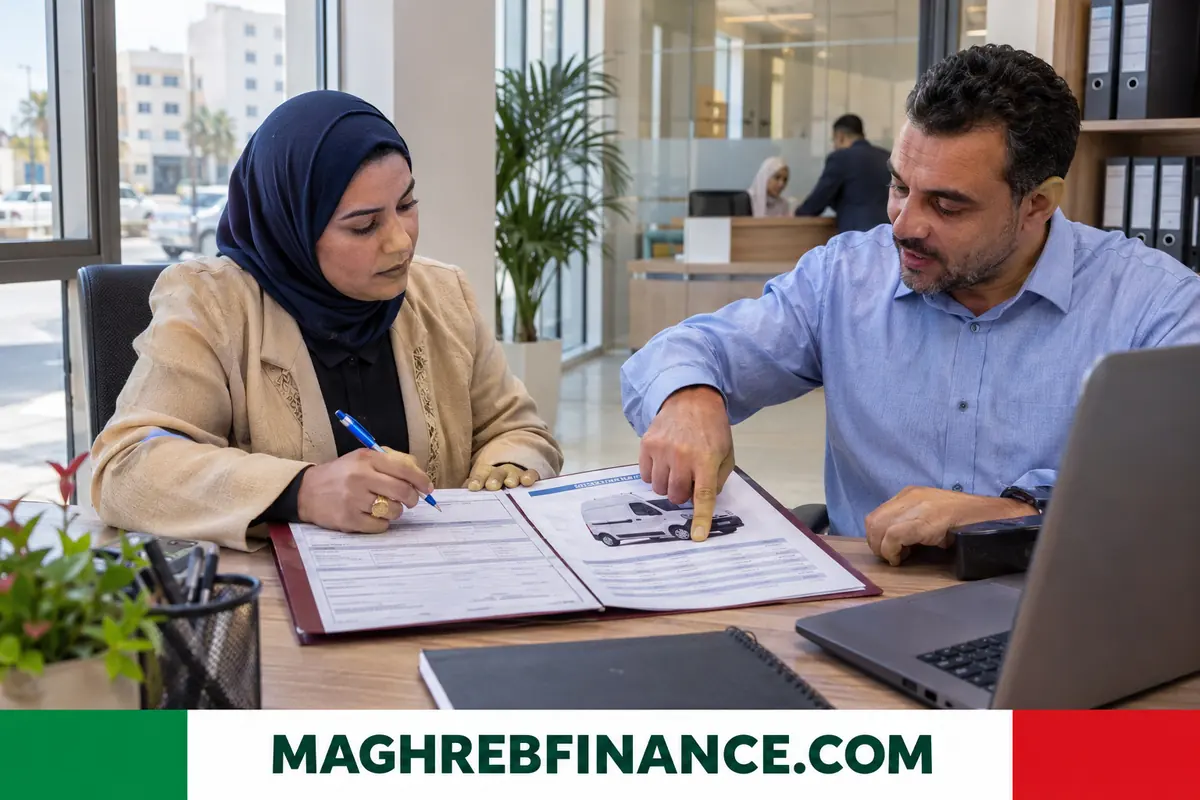
In Libya, car leasing with a purchase option is a form of personal financing that lets an individual use a vehicle against periodic payments and become its owner at the end of the contract. It is offered mostly through Islamic-style banking windows, because the law prohibits interest in Libyan dinar (LYD) lending. The Central Bank of Libya supervises the banks involved, and the structure resembles ijara, where the lessor owns the car during the lease and transfers title once all payments are complete.
Car leasing with a purchase option: how it works
The bank or leasing company buys the car chosen by the customer and keeps legal ownership while the customer drives it. Payments cover the use of the car and, in the final stage, the transfer of ownership.
The contract states the price, the duration, the payment dates and how title passes. Customers should read the transfer clause with particular care.
Delivery occurs after the lessor pays the dealer, and the customer signs a receipt confirming that the car matches the description and is in good condition.
This receipt matters if a defect appears later, because it fixes the date on which responsibility for the car begins.
Leasing compared with a murabaha car purchase
In a murabaha, the customer owns the car from the first day and the bank holds a guarantee. In a lease with a purchase option, the lessor remains the owner until the end.
That difference matters for maintenance, insurance and what happens if payments stop. The lessor can usually recover the car more easily than a bank holding only a guarantee.
Some customers choose leasing because the lessor's ownership gives the bank stronger security, which can lead to a lower advance payment than in other structures.
Others prefer a murabaha because they become the owner at once and can sell the car sooner.
Eligibility and documents
Typical requirements include identity papers, a salary certificate or proof of business income, recent bank statements and a pro forma invoice from the dealer. A guarantor may also be requested.
Applicants with a salary paid into the same bank are often preferred. Self-employed buyers should prepare tax or trade-licence documents.
Applicants should confirm the age of the driver, the validity of the driving licence and the permitted use of the car, since private and commercial use are often treated differently.
Ask the lessor whether it accepts a co-signer if the main applicant's income is irregular.
Costs to compare
Look at the advance payment, the total of all instalments, the administration fee and any insurance charged by the lessor. A low monthly sum can hide a long term and a higher total.
Ask whether registration, plates and technical inspection are included, and who pays them.
Currency is another point to check. Contracts are normally set in Libyan dinars, but if the dealer prices in foreign currency, ask how the exchange rate is fixed and who bears any change.
Request the complete schedule showing each payment and the final transfer amount.
Insurance and maintenance
Third-party liability insurance is compulsory for vehicles in Libya, and lessors normally require fuller cover as well. The policy is often issued with the lessor as beneficiary.
The contract should say who pays for repairs and routine servicing. In most Islamic lease structures, major ownership-related repairs fall on the lessor, while daily upkeep falls on the user.
Coverage for passengers, fire and theft is an extra that lessors often require, and it increases the monthly outlay.
Check whether the insurer has a repair network in the customer's city.
Late payment, accident and theft
Because interest cannot be charged, lessors use other tools, such as repossession or a fixed administrative fee. Ask which applies and when the lessor may end the contract.
After an accident or a theft, report it to the police and to the insurer quickly, then inform the lessor. The contract should explain how the insurance payout settles the remaining balance.
Keep a copy of the police report and the insurer's reference number, because the lessor may ask for both before it agrees to repair or replace the car.
Never repair a leased car at an unapproved garage without asking, since the contract may require approved workshops.
Repairs paid by the insurer should be documented with invoices.
Ending the contract
At the end, the customer pays the agreed final amount, which may be nominal, and signs the transfer of title. The documents should be kept and the registration updated without delay.
If the customer wishes to leave early, check the early settlement rule. Some lessors reduce the remaining balance, while others require the full amount.
Avoid leasing a car at the limit of the household budget. Fuel, servicing, insurance and parking all come on top of the contract payment.
A short test of the real monthly cost before signing prevents later difficulty.
Practical advice for buyers in Libya
Prices of new and used cars have moved with exchange rates and import difficulties, so compare quotes from several dealers before the lessor buys.
Prefer written offers over verbal promises, and make sure the car delivered matches the invoice by chassis number.
Frequently asked questions
Do I own the car during the lease?
Usually not. The lessor owns it until the final payment, and ownership passes to you when the contract is complete.
Is a down payment required?
Most lessors ask for an advance, whose size depends on the car, the lessor and the customer's profile.
Can I lease a second-hand car?
Some lessors allow it with an inspection and a clear title, while others finance only new cars from approved dealers.
What if I cannot continue paying?
Speak to the lessor at once. Options may include rescheduling, a sale of the car or its return, according to the contract.