
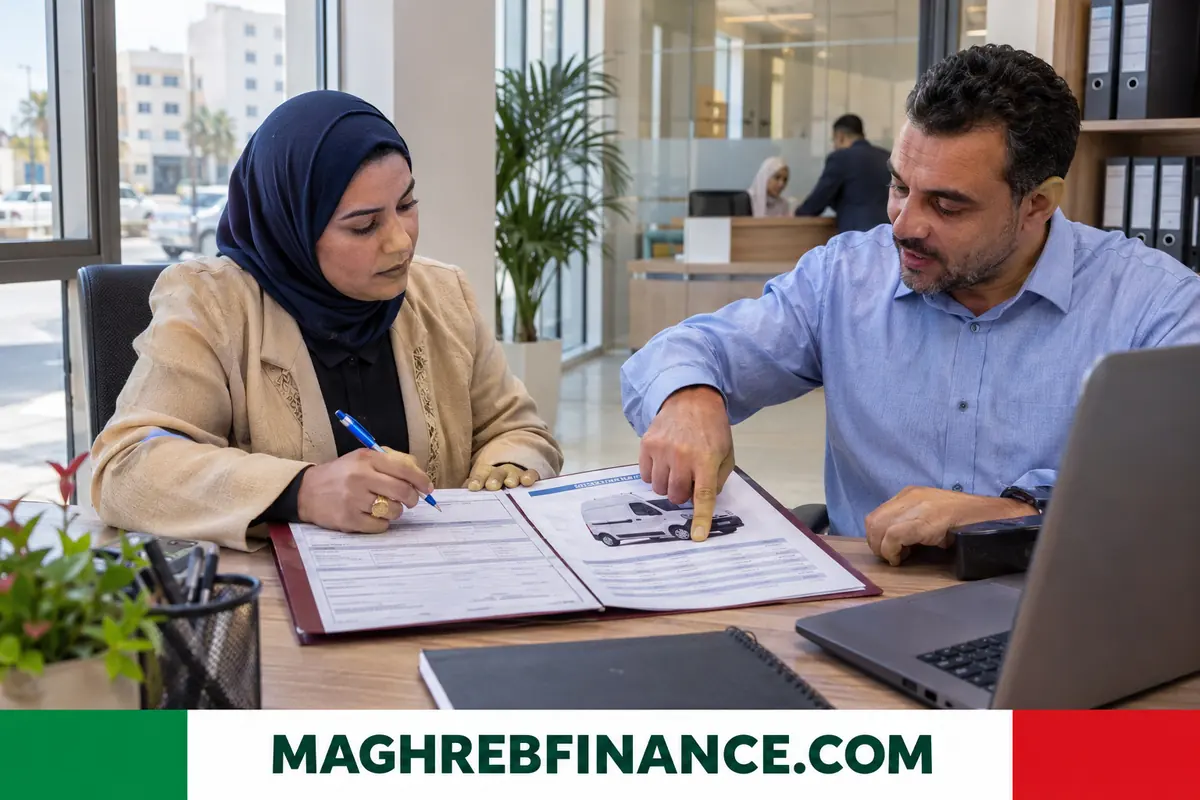
In Libya, inclusive long term car leasing bundles the vehicle with services such as insurance, servicing and replacement support in a single regular payment. Customers use the car without buying it, and the lessor stays the owner throughout. The product is still uncommon in Libyan dinar (LYD) markets, where most vehicles are bought outright or through murabaha, and it falls under the Central Bank of Libya's general supervision of financing companies. Terms depend heavily on the lessor and the contract.
Long-term car leasing with services: the principle
The customer chooses a car and a duration, often three to five years, and pays a fixed amount that covers use, insurance and a package of maintenance. At the end the car goes back to the lessor.
This differs from a purchase option lease because no transfer of ownership is planned. The customer is paying for use and convenience, not for eventual ownership.
The attraction is predictability: one payment replaces separate bills for servicing, tyres and cover.
Contracts differ in whether the lessor or the customer chooses the garage, so ask this early.
Who uses this kind of lease in Libya
Companies, oil-sector contractors, international organisations and professionals who need a reliable vehicle are the main users. Individuals with stable income can also ask for it, although offers are fewer.
Families who change cars often, or who do not want to deal with garages and spare parts that are hard to find, may value the service element more than the price.
Smaller firms sometimes use inclusive leasing for sales teams, because a single invoice simplifies accounting and removes the need to keep a workshop.
What the monthly payment normally includes
Check the contract for each element rather than assume. A complete package may include the following.
- Insurance, at least third-party liability and often comprehensive cover.
- Periodic servicing and wear parts according to the manufacturer's schedule.
- A replacement vehicle during long repairs.
- Roadside assistance and vehicle registration.
Fuel, fines, tyre damage from misuse and repairs after careless driving are usually excluded.
Mileage, wear and return conditions
Contracts set an annual distance limit, and exceeding it brings an extra charge per kilometre. In a country with long distances between cities, estimate your yearly driving before signing.
When the car is returned, the lessor inspects it. Normal wear is accepted, but dents, torn seats or missing equipment may be billed.
Take dated photographs at delivery and at return, and ask for a written inspection report.
Tyres, brake pads and batteries wear faster on poor roads, so confirm whether the package covers them or only scheduled servicing.
Documents and eligibility
Applicants present identity papers, a driving licence, proof of income or a company registration and bank references. Some lessors ask for a deposit or a bank guarantee instead of a down payment.
A company may need to provide its commercial register extract, tax card and a list of authorised drivers.
Ask whether the deposit is returned at the end and under what conditions.
Sharia compliance and the legal setting
Because the law bans interest, lessors present their offers as ijara, a lease in which payments are for the use of an asset the lessor owns. A sharia board or the bank's religious adviser often reviews the model.
Customers can ask to see the approval and can request an explanation of how the service fee is justified.
Customers may also ask whether the lessor allows additional drivers from the same family, since that affects insurance.
Risks and points to negotiate
The main risks are early termination charges, limited service networks outside big cities and unclear rules on accidents. A lessor that cannot supply parts quickly can leave the customer without a car.
Negotiate the notice period for ending the contract, the cover for a replacement car and the repair garages that are accepted.
Compare the total payment over the full term with the price of buying a similar car and running it yourself.
Ask what happens to the deposit and the payments already made if the lessor ends the contract because of a late payment.
Comparing leasing with buying
Buying a car ties up savings and exposes the owner to resale risk, which can be hard to estimate when prices move with exchange rates and import supply. Leasing shifts part of that risk to the lessor, at a cost built into the payment.
Run a simple comparison: add all payments, subtract nothing for resale, and set the total beside the expected cost of owning, including fuel excluded, servicing, insurance and repairs. If the figures are close, convenience may decide.
Seek a written quotation from two lessors so you can see which services they actually deliver.
Typical questions to put to the lessor
Before signing, ask how long the lessor takes to deliver a replacement car, whether it covers journeys to other cities and how accidents abroad or in conflict-affected areas are treated.
Check also what happens if the lessor changes its business or closes a branch during the term, since the customer still depends on its network for repairs.
Insist that every promise, from the replacement car to the garage network, appears in the written contract.
Frequently asked questions
Is insurance included in the monthly payment?
Usually yes in an inclusive lease, but confirm whether it is third-party only or comprehensive and who pays the excess after a claim.
Can I end the lease early?
Early termination is allowed in some contracts but normally carries a charge, so read the clause and the notice period before signing.
Who repairs the car?
The lessor arranges servicing and mechanical repairs under the package, while damage caused by misuse can be charged to the customer.
Do I own the car at the end?
No. The car is returned, unless the contract expressly adds a purchase option, which then falls under a different structure.