
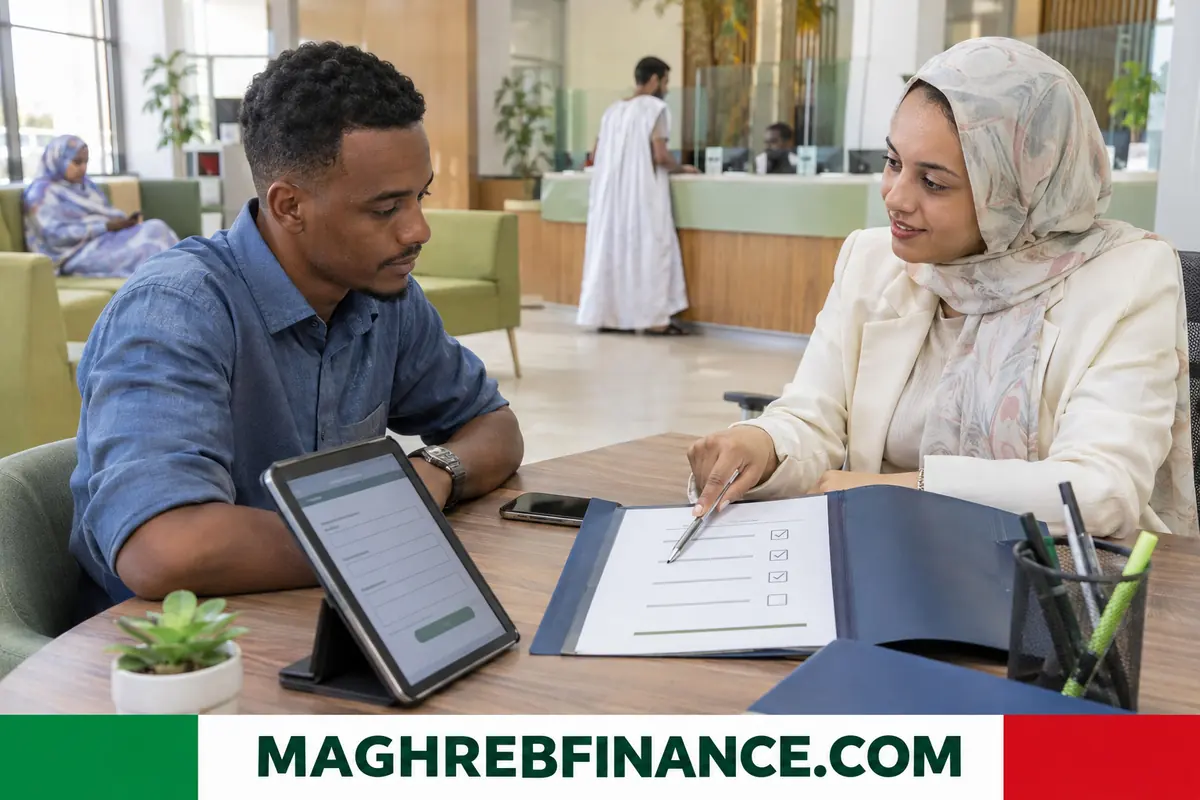
In Mauritania, a current account, also called a checking account, is the base of everyday banking services for employees, civil servants, traders and students. It holds money repayable on demand, receives salaries and transfers, and is kept in ouguiyas (MRU), the national currency. Banks licensed by the Central Bank of Mauritania open these accounts after identity and income checks, and several offer Islamic-compliant versions. The account normally comes with a card, a cheque book and remote access, but conditions, fees and minimum deposits differ from one bank to another.
What a current account is used for
A current account is a demand deposit account: funds can be withdrawn at any moment, with no lock-in period. It is where a salary, a pension or business takings arrive, and from where rent, school fees and utility bills are paid.
Unlike a savings account, it is not designed to grow capital. Its value lies in safety, proof of transactions and access to payment tools, which matters in a country where cash is still widely used for small purchases.
A regular account history also supports a later request for financing, because a bank can see how income and spending behave.
Opening an account: documents and steps
Banks ask for a valid identity document, recent photographs, proof of address, proof of income or occupation and a specimen signature. The Banque Populaire de Mauritanie, for example, publishes a list of required documents on its website and sets an initial deposit at opening. The amount differs by bank and by package.
Usual steps
- Choose the bank and the package, either a simple account or a bundle with card and remote services.
- Complete the form and sign the general conditions.
- Make the initial deposit and collect the card and cheque book when they are issued.
- Activate mobile or online banking where it is offered.
Some banks now accept applications by phone or app, especially for customers living abroad.
The cheque: how it works and what can go wrong
A cheque is a written order to the bank to pay a sum to a named beneficiary. It requires enough funds at the moment it is presented. A cheque without funds exposes the issuer to rejection, bank charges and legal penalties, and it can lead to registration in payment incident records kept under central bank supervision.
To reduce risk, write in ink, state the amount in figures and in words, cross out blank spaces, date the cheque and keep the counterfoil. A crossed cheque can only be paid into a bank account, which makes theft less attractive.
Never sign a blank cheque, and confirm the identity of the beneficiary before handing it over.
Everyday services around the account
Beyond the cheque book, the account gives access to a debit card, transfers, periodic statements and remote monitoring. Many Mauritanian banks offer an app or a text-message service to check balances. The Banque Al Wava Mauritanienne Islamique, for instance, offers a mobile application allowing real-time transfers, cheque book requests and statement downloads.
Packages and options
Banks often bundle card, remote banking, card insurance and a limited overdraft into a single monthly price. Comparing the price of the package with the sum of its parts avoids paying for options you will not use.
Fees and tariffs to compare
Banks publish a tariff schedule that lists charges for account keeping, card, cheque book, transfers, withdrawals from another bank's machine and paper statements. Ask for the current list and keep a copy.
A low balance with many small operations can cost more than it protects. Check minimum balance rules, charges for inactivity and the price of rejected payments before choosing an institution.
The cheapest account on paper is not always the best, since branch density, opening hours and quality of remote banking also matter.
Salary domiciliation and daily management
Employers and public administrations often pay salaries into a bank account, and the bank may offer a package with a card, an overdraft facility or a personal loan for employees. The Banque Populaire de Mauritanie, for example, presents distinct offers for employees and civil servants.
A budget with fixed outgoings, such as rent and school fees, and a small cash reserve makes account management easier. Set text alerts to see each movement and report any unknown operation immediately.
Avoid sharing your card or PIN with relatives or colleagues, even for convenience.
Rights of the account holder and complaints
The holder has the right to clear information on fees, to regular statements and to a reply to complaints within a reasonable time. If a disagreement arises, write to the branch, then to the bank's management, and then you may refer the matter to the Central Bank of Mauritania, which supervises credit institutions.
Keep documents, receipts and messages related to the dispute. A precise date, amount and reference make a complaint easier to examine.
Closing an account requires a written request, return of cards and cheque books and settlement of any balance owed.
Frequently asked questions
Can a foreigner open a current account in Mauritania?
Usually yes, with a valid passport or residence document, proof of address and the documents requested by the bank. Rules differ by institution.
Is a cheque book always issued with the account?
Not always. Banks may issue it after a trial period or on request, depending on their policy and on how the account has been operated.
What currency is the account held in?
Standard accounts are held in ouguiyas (MRU). Some banks also offer accounts in foreign currencies under exchange rules.
What happens if I issue a cheque without funds?
The cheque is rejected, charges apply and the incident may be recorded, with legal consequences and restrictions on issuing cheques.
Where can I complain about a bank?
Start with the branch and the bank's management, then the Central Bank of Mauritania if the response is not satisfactory.