
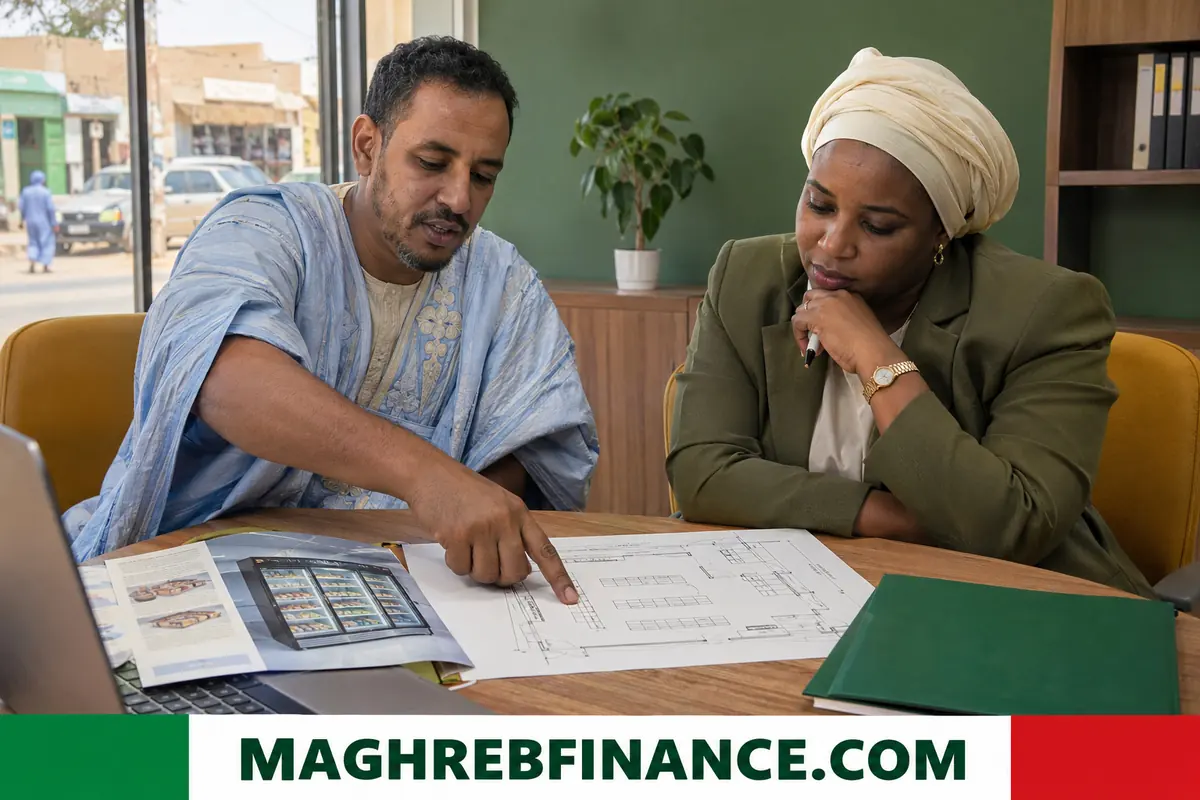
In Mauritania, Islamic business financing relies on contracts such as Murabaha, Istisna and Musharaka, which replace the interest-bearing loan with the purchase of an asset, manufacture to order or a partnership of capital. It serves to acquire equipment, finance stock or launch an activity. Several banks in the market offer it under the supervision of the Central Bank of Mauritania, with compliance committees checking that every operation respects Islamic principles, and prices are quoted in ouguiya (MRU) or, in some cases, in foreign currency.
Participatory and Islamic financing: equipment Murabaha: principles that set these products apart
Islamic finance forbids interest, called riba, as well as excessive uncertainty and pure speculation. Each financing must be backed by a real asset or an identifiable economic activity, and risks are shared between bank and client.
In practice the bank does not lend money against interest. It buys an asset and resells it, funds a manufacture or joins the project, and its income comes from a margin agreed in advance or a share of results.
This changes the relationship: the bank becomes a temporary owner or a partner, which brings checks on how funds are used and more detailed documents than for an ordinary loan.
Murabaha: purchase and resale with a margin
Murabaha is the most common contract. The company asks the bank to buy equipment, raw materials or goods from a named supplier. The bank buys, becomes owner, then resells to the company with a known margin and deferred or staged payment.
The resale price no longer changes even if instalments are delayed, which gives full visibility. Terms run from a few months for working capital to several years for equipment, and a revolving version sets a ceiling within which the company orders several times.
An importer of spare parts can ask the bank to buy them directly from the foreign supplier and resell them on credit, so the supplier is paid at once and the final cost is known at signature.
Istisna for manufacture and construction
Istisna is a contract of manufacture to order. The company asks the bank to have an asset produced or built to specification, such as a special machine, an industrial building or a factory fit-out.
The bank gives the work to a contractor and then sells the finished asset to its client with staged payment. It suits long projects, since the price can be settled as work advances.
The bank bears the completion risk but relies on a precise contract with the maker, deadlines and penalties. For a warehouse build, funds may be released in stages against expert-approved work statements, and the company pays once the building is delivered or on an agreed timetable.
Musharaka and Mudaraba: two forms of partnership
Musharaka is a partnership in which the bank and the company each bring funds to a project, share profits at an agreed ratio and bear losses in proportion to their contribution. Mudaraba links a capital provider with an entrepreneur who runs the activity, and financial losses fall on the investor unless the manager is at fault.
These contracts need a monitored project, transparent accounts and mutual trust. Banks still use them cautiously because the risk is higher than in Murabaha.
They appear more often in investment deposits than in company financing, but some structured projects use them. Sharing losses is what sets them apart from credit, so expect frequent reporting and a say in management.
Salam and Ijara for other needs
Salam is payment in advance for goods to be delivered later, such as a crop. The farmer gets funds before delivery and the bank earns by reselling the produce. It suits producers who must finance a season, especially in the farming areas along the river valley, where the delivery of produce lets the bank be repaid without a working capital loan.
Ijara is a lease contract: the bank buys an asset and makes it available to the company against instalments, with a transfer of ownership at the end in the version with a promise of sale. It corresponds to leasing.
Both contracts widen the range and cover needs that Murabaha does not handle well.
Access conditions and documents
The criteria resemble those of a conventional bank: an identified activity, accounts, repayment capacity and guarantees. The file contains the articles of association, trade register extract, tax identifier, financial statements, supplier or builder quotation and, for a new project, a business plan.
The bank sometimes requires a contribution and security such as a pledge on the equipment, a mortgage or a surety. In Murabaha the asset itself stays pledged until full payment.
Procedures are a little longer because the bank must buy from the supplier: it compares quotations, checks the supplier, places the order, receives the goods and invoices its client. Allow for this, especially for imported equipment passing through the port.
Cost, risks and checks
Cost is expressed as a margin, not a rate, but it can still be compared with conventional loans by calculating the total paid over the term. Check arrangement fees, insurance and the effect of late payment, since some banks keep penalties and pass them to charity.
The main risk is believing an Islamic product is necessarily cheaper or lighter: it remains a firm commitment. Read the contract, ask who owns the asset at each stage and who bears loss in case of damage.
Legal advice helps for a large amount, and an accountant should confirm the tax treatment of a purchase followed by a resale, notably for VAT and registration duties.
Frequently asked questions
Is Murabaha an interest-bearing loan in disguise?
Legally no, because the bank really buys the asset and bears its risk before reselling at a price fixed in advance.
Can non-Muslim companies use these products?
Yes, they are open to any company regardless of the religion of its managers.
What separates Murabaha from Ijara?
Murabaha transfers ownership at the sale with deferred payment, while Ijara provides the asset against instalments, with ownership possibly passing at the end.
Can working capital be financed?
Yes, through a short Murabaha on goods or raw materials, generally for one to twelve months.
Who checks the compliance of contracts?
A compliance committee within each bank, under the general supervision of the Central Bank of Mauritania.