
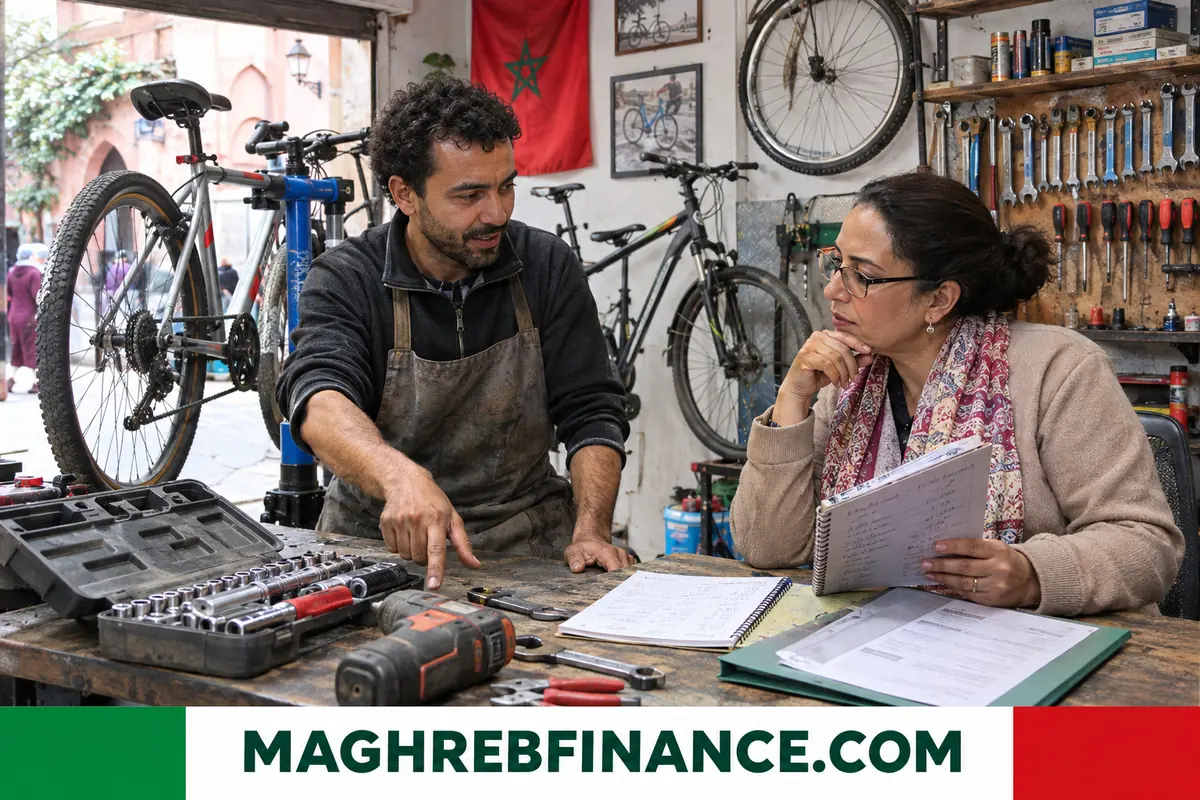
In Morocco, business microcredit and honour loans are two sources of entrepreneur financing for people who cannot easily obtain a standard bank loan. Business microcredit is a small repayable loan in dirhams granted by a microfinance association or company supervised by Bank Al-Maghrib. An honour loan is a personal loan to the founder, usually interest-free and without guarantees, awarded by a network or programme that supports business creation, and it often unlocks a larger bank loan, which makes the two tools complementary for small projects.
Business microcredit and honour loans: two tools with different roles
Business microcredit finances the activity itself: goods, raw materials, small equipment or working capital. It is repaid in regular instalments, usually monthly, at an interest rate that covers the institution's costs. Amounts are modest and rise step by step when the client repays on time, which builds a credit history.
An honour loan is made to the founder personally, not to the company, and is injected into the business as a contribution. It acts as a lever: a bank is more willing to lend when the founder has already obtained such support.
A seamstress buying fabric and a street vendor renewing stock are typical microcredit clients, while a young graduate launching a small digital agency is a typical honour loan candidate.
Who grants these financings in Morocco
Moroccan microfinance rests on associations and licensed financing companies. Al Amana, Attawfiq Micro-Finance and Fondep are among the best-known names. They operate in towns and countryside, with local branches and advisers who visit customers to assess the activity on site.
Honour loans are mainly offered by entrepreneur networks, such as Réseau Entreprendre Maroc, and by support programmes for young founders. The selection often includes an interview before a committee.
Eligibility and borrower profile
A microcredit targets an income-generating activity that is running or starting, carried on individually or in a small group. The institution examines the regularity of the activity, repayment capacity and the borrower's reputation in the neighbourhood or village.
Women entrepreneurs and rural residents are historic target groups of Moroccan microfinance. An honour loan, by contrast, rewards the quality of the project, the founder's commitment and the potential to create jobs, and is often reserved for innovative or growth-oriented businesses.
Applicants should be ready to explain their experience, their customers and the way they set prices.
Documents to gather before applying
The papers requested are lighter than for a bank file, but they must be truthful and consistent with one another.
- National identity card and proof of address;
- a description of the activity with photographs of the shop, workshop or stall;
- a record of recent sales or purchases, even kept in a notebook;
- for an honour loan, a presentation file, a financing plan and a projected budget.
A clear explanation of how the money will be used and how the instalments will be paid helps the loan officer to decide. Borrowers should keep a copy of everything they sign.
Costs and repayment to compare
The rate of a microcredit is higher than that of a bank loan, because following small amounts is costly for the institution. The total cost, including arrangement fees and insurance, should be compared and not only the quoted rate. Asking for the full amortisation table shows the exact amount of each instalment.
An honour loan carries no interest, but it is repaid after a deferral period and the amount is limited. It usually has to be used alongside a bank loan, and the founder remains personally responsible for repayment even if the business fails.
Some institutions offer a lower rate to repeat borrowers who have a clean record, so a first small loan can pave the way to cheaper credit later.
Risks and precautions
The main danger is over-indebtedness through accumulation: borrowing from several lenders to repay a first loan quickly leads to a dead end. The borrower should check that the institution is licensed and refuse any loan offered against an advance payment of fees, a classic sign of fraud.
A late payment may bring penalties and block later loans. It is better to speak to the loan officer as soon as difficulty appears, because many institutions can reschedule instalments for borrowers who communicate early and honestly.
Group guarantees, where several borrowers answer for one another, create social pressure that can be hard to bear, so the commitment should be understood fully before it is made.
Rights of borrowers and recourse
The consumer protection law requires clear information about the cost of credit, the term and the amount of instalments. The borrower receives a written contract and may ask for a copy in French or Arabic.
In a dispute, the first step is the institution's complaints service, then Bank Al-Maghrib, which supervises the sector, or a consumer protection association. Keeping receipts for every repayment gives the borrower proof in case of disagreement.
Associations of consumers and local advice offices can help read the contract, and keeping all documents in one folder simplifies any complaint.
Frequently asked questions
What is an honour loan?
A personal, usually interest-free loan to a founder, awarded by a network or programme, which helps obtain bank financing.
How much can be borrowed through microcredit?
Amounts are modest and grow by steps as repayments are made on time. The institution sets the ceiling.
Is a guarantee required?
Microcredit often relies on character and activity checks, sometimes with a group or personal guarantee, while honour loans need none.
Can both be combined?
Yes. Many founders use an honour loan as a contribution and then obtain a microcredit or a bank loan.
How can a lender be checked?
Ask whether it is licensed and supervised by Bank Al-Maghrib, and never pay fees in advance to obtain a loan.