
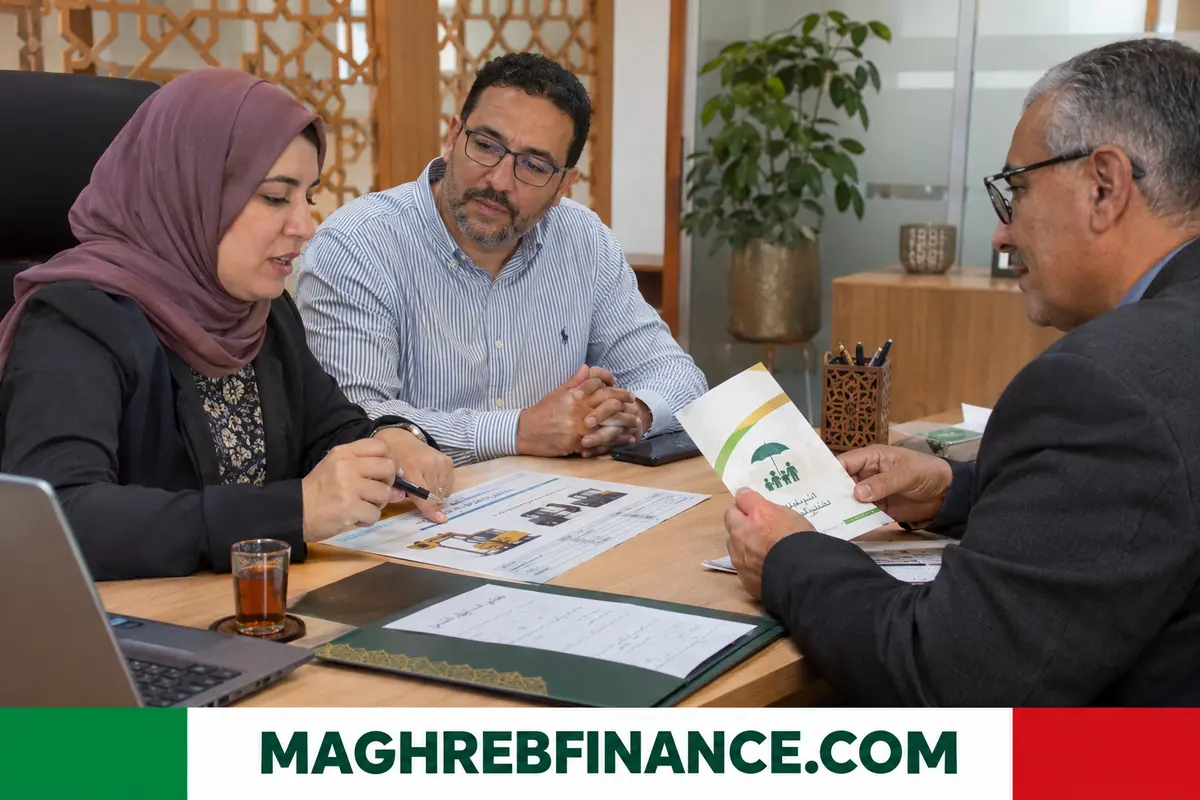
Morocco offers business Takaful, a participatory form of cover for company fleet insurance and other professional risks. Participants pay contributions into a common fund that compensates those among them who suffer a loss, while an operator manages the fund for a fee. The contract can protect premises, equipment, civil liability, vehicles and other trade risks, in dirhams (MAD). Traders, craftsmen, hauliers and small firms that want an ethical cover consistent with their beliefs find in it an alternative to conventional insurance.
The principle of participatory insurance
Takaful rests on mutual help. Participants agree to contribute to a fund and to compensate one another in case of loss, instead of transferring risk to a company in exchange for a premium.
The operator does not own the fund. It manages the money, pays claims, covers expenses and receives a fee or a share of investment profits, depending on the model.
Funds are invested in activities that respect the rules of Islamic finance, avoiding interest, gambling and prohibited sectors.
For a business owner, this means the contract is judged twice: on the quality of the insurance service and on the credibility of the ethical rules attached to it.
A legal and religious framework
In Morocco, participatory insurance operates under insurance law and supervision, with ACAPS overseeing licensed operators. Religious conformity is reviewed by competent Sharia authorities, which examine contracts and investment rules.
The framework aims to give clients both legal certainty and confidence that the product respects their values.
Companies should ask who the operator is, which supervisory body licensed it and how Sharia compliance is checked and reported. A reliable operator publishes its governance structure and annual results in plain language.
Covers available to businesses
A Takaful offer for professionals may include fire and multi-risk cover for premises, theft, equipment breakdown, liability towards third parties, goods in transit and employee-related risks.
The range depends on the operator, which may be a dedicated company or a window of a conventional insurer, and not every cover is always available.
Small firms should confirm which risks are in the offer and which remain with conventional insurers, such as workplace accident cover, which the law requires employers to place with an approved insurer.
Takaful for vehicle fleets
Fleets of vans, lorries, taxis or delivery vehicles can be insured under the participatory model. Compulsory third-party liability follows the legal rules, while optional covers such as theft, fire and collision add protection.
Management of claims, declarations of vehicles and discounts for good records work much as in a conventional fleet contract.
What changes is the legal structure: contributions go to a fund, and any surplus after claims and costs may be shared or returned according to the rules of the contract. Fleet managers should ask how the surplus is calculated for a large group of vehicles with a very different claims record.
Contributions, costs and surplus sharing
Contributions are set from the same risk factors as ordinary premiums: activity, value insured, claims record and limits. A portion goes to the fund, and a portion pays operator fees.
If the fund ends the year with a surplus, the contract may distribute it to participants, keep it as a reserve or reduce the next contributions.
If claims exceed the fund, the operator may provide an interest-free loan to be repaid from future surpluses. Ask for the exact rules in writing, including who decides on distribution and how it is audited.
Differences from conventional insurance in Morocco
The main differences are the ownership of the fund, the way surplus is handled, the separation between operator and participants and the ethical filter on investments.
In practice the client still receives a contract, pays contributions and claims compensation, so day-to-day experience can feel similar.
Price and service levels should be compared in the same way as for any insurance, since an ethical label does not guarantee a lower cost or a wider cover. Request quotes on identical limits and excesses to make the comparison fair.
How to subscribe and what to check
Identify the operator, request the general conditions and the specific conditions for professionals, and compare them with at least one conventional offer.
Check the covered risks, the limits, exclusions, waiting periods, claims procedure and the rules on the surplus.
- Confirm the licence of the operator.
- Read how Sharia compliance is supervised.
- Ask for a worked example of a claim.
Keep the signed documents and any declarations about the business activity, which must be accurate. An omission or a wrong declaration can reduce compensation just as in any other insurance.
Claims, rights and recourse
A loss must be reported quickly and documented with photographs, invoices and, if needed, a police report. The operator appoints an expert and pays within the terms of the contract.
Participants keep the same rights as other policyholders to receive a reasoned decision and to complain if they disagree, including when the dispute concerns the share of the surplus or the interpretation of an exclusion.
Complaints are first addressed to the operator, then to the supervisory authority or the courts. Keeping copies of correspondence helps in any dispute.
Frequently asked questions
Is Takaful insurance suitable for any company?
Yes, if it offers the covers the business needs. Check the range, since some risks may only be insured conventionally.
Who owns the money in the fund?
The participants collectively. The operator manages it and receives a fee, but does not own the contributions.
Is vehicle cover under Takaful legally valid?
Yes, provided the operator is licensed and the contract includes the compulsory third-party liability required by law.
Do participants always receive a share of the surplus at year end?
Not always. It depends on the contract, which may distribute the surplus, keep it as a reserve or reduce later contributions.