
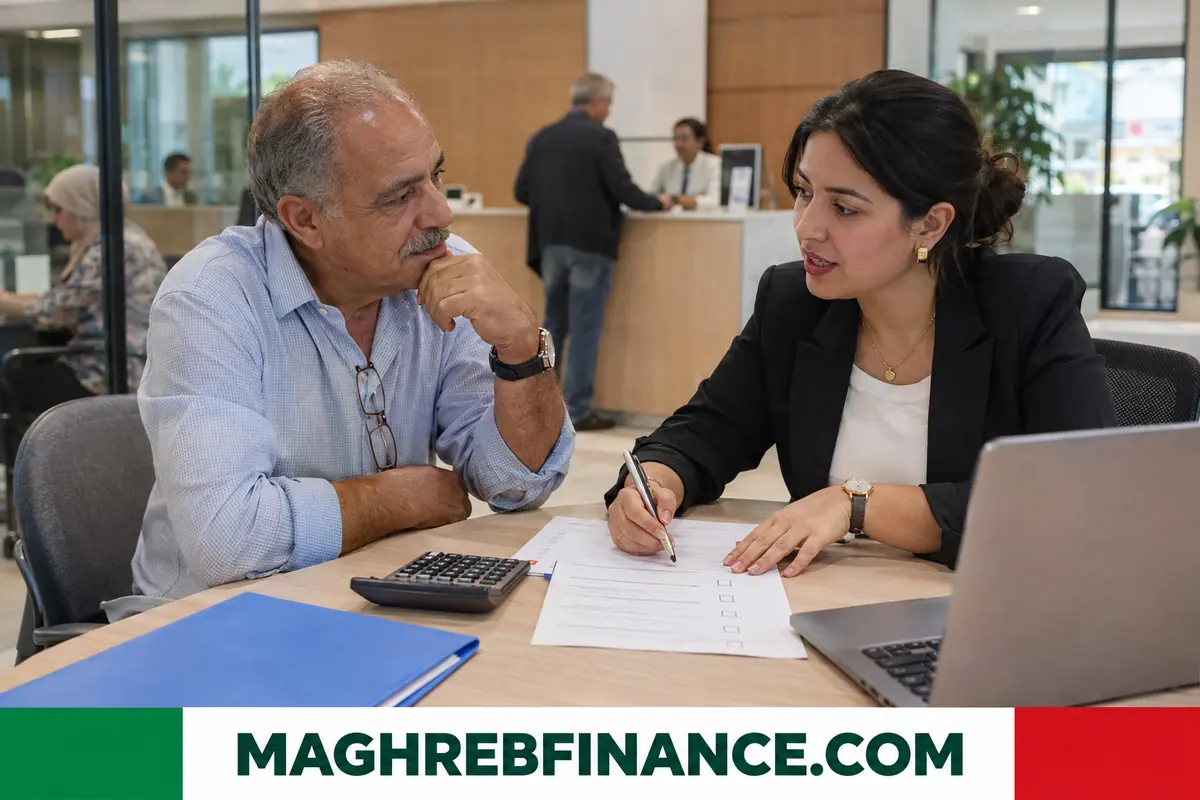
In Tunisia, unrestricted personal loans are consumer loans that an individual may use freely, for family spending, care, repairs or travel, with no invoice to justify the financing. The bank pays the sum into the account in Tunisian dinars (TND) and the borrower repays it in monthly instalments, often taken from a salary paid into the same bank. It differs from an earmarked loan tied to one purchase, and it depends mainly on income stability, under the prudential rules of the Central Bank of Tunisia.
Unrestricted personal loan: A loan with no required purpose
The principle is freedom of use. Unlike an earmarked loan, which finances an identified item against an invoice, an unrestricted personal loan requires no proof of how the money is spent. The bank cares about the ability to repay, not about what the borrower buys.
This simplicity makes it popular for mixed needs, such as a family event, a repair and a small debt, in a single operation.
Because no invoice is needed, the bank often sets a lower ceiling than for an earmarked loan, and it may ask for a salary domiciliation to reduce its risk.
Who can obtain it
The main public is made up of employees, in particular public servants and staff of large firms, whose income is regular and paid into the bank. Pensioners with a regular pension can also access it within limits, and some banks open it to self-employed clients with a solid account history.
The bank checks age, seniority, existing debts and the conduct of the account before giving its answer.
A recent change of employer, a trial period or a fixed-term contract can lead to a lower amount or a refusal, so job stability is worth documenting.
Amount, duration and instalment
The amount granted depends on income, charges and the bank's policy. A common rule is to limit all credit instalments to a reasonable share of net income. Terms run from a few months to several years, and longer terms lower the instalment but raise the cost.
Before accepting, test the instalment against the real monthly budget, including rent, schooling and other loans.
Rounding the amount down to what is truly needed keeps the cost lower than borrowing the maximum offered.
Rate, fees and insurance
The interest rate may be fixed or variable. A variable rate is based on a money market index plus a margin and can therefore rise. Fees include file charges, sometimes stamp duty, and borrower insurance, which is often compulsory.
The effective overall rate gathers these items and should be requested in writing. Two offers with the same nominal rate can differ widely once fees and insurance are added.
Ask whether the insurance is optional, what it covers and whether it can be taken elsewhere at a lower price.
Steps of the application
The request starts with a simulation online or in a branch, followed by the filing of documents: identity papers, proof of address, pay slips and bank statements. The bank studies the file, consults the Central Bank's risk files and notifies its decision.
A loan offer is then handed to the borrower, who has a legal period to read it before signing. Funds are paid once the contract is signed and any salary assignment is registered.
Keep copies of every document sent to the bank, with the date, because they help if the file is lost or delayed.
Precautions and risks
The main risk is over-indebtedness: multiplying small loans for day-to-day spending ends in a budget blocked by instalments. Before borrowing, check whether the expense can be spread otherwise, funded by savings or postponed.
Missed payments bring penalties, a record in the credit register and, in the end, recovery procedures that can affect the salary. Keeping a margin in the budget and warning the bank early if difficulties appear improves the options.
A written budget that lists income and fixed charges shows how much room is left for an instalment, before any request is made.
Alternatives to consider
Several options deserve a look before signing: an authorized overdraft for a one-off need, an earmarked loan if the expense is a specific purchase, an advance from the employer or a social fund in certain situations, or microcredit for a small business activity.
A family loan, documented in writing, can also avoid bank interest, as long as repayment terms are realistic and clear to both sides.
Whatever the alternative chosen, write down the total cost in dinars and compare it with the benefit of the expense, since the loan should serve a clear need.
Rights of the borrower
The borrower has the right to clear information on rate, costs and duration before signing, to a copy of the contract and the amortisation table, and to repay early in accordance with the contract terms. A complaint goes first to the bank and then to the Central Bank of Tunisia.
Keeping the contract, the table and all payment receipts in one folder simplifies any later discussion.
Free consumer advice services can explain the contract before signature.
Frequently asked questions
Do I have to justify what I use the money for?
No. The loan is unrestricted, so the bank asks about repayment capacity rather than the purpose.
Is an unrestricted loan more expensive than an earmarked one?
Often the rate is somewhat higher, because the bank has no asset tied to the loan. Compare the effective overall rate of each.
Can I repay earlier in Tunisia?
Usually yes, with conditions or a fee set in the contract. Ask for the rule before signing.
Can a pensioner get this loan?
Sometimes, within age and amount limits, if the pension is regular and paid through the bank.
What if I cannot pay an instalment?
Contact the bank at once. A rescheduling may be possible, whereas silence leads to penalties and recovery steps.
Further reading
- Amen Bank : Tunisian commercial bank whose English-language site offers online simulation of credits and a mobile banking application.