
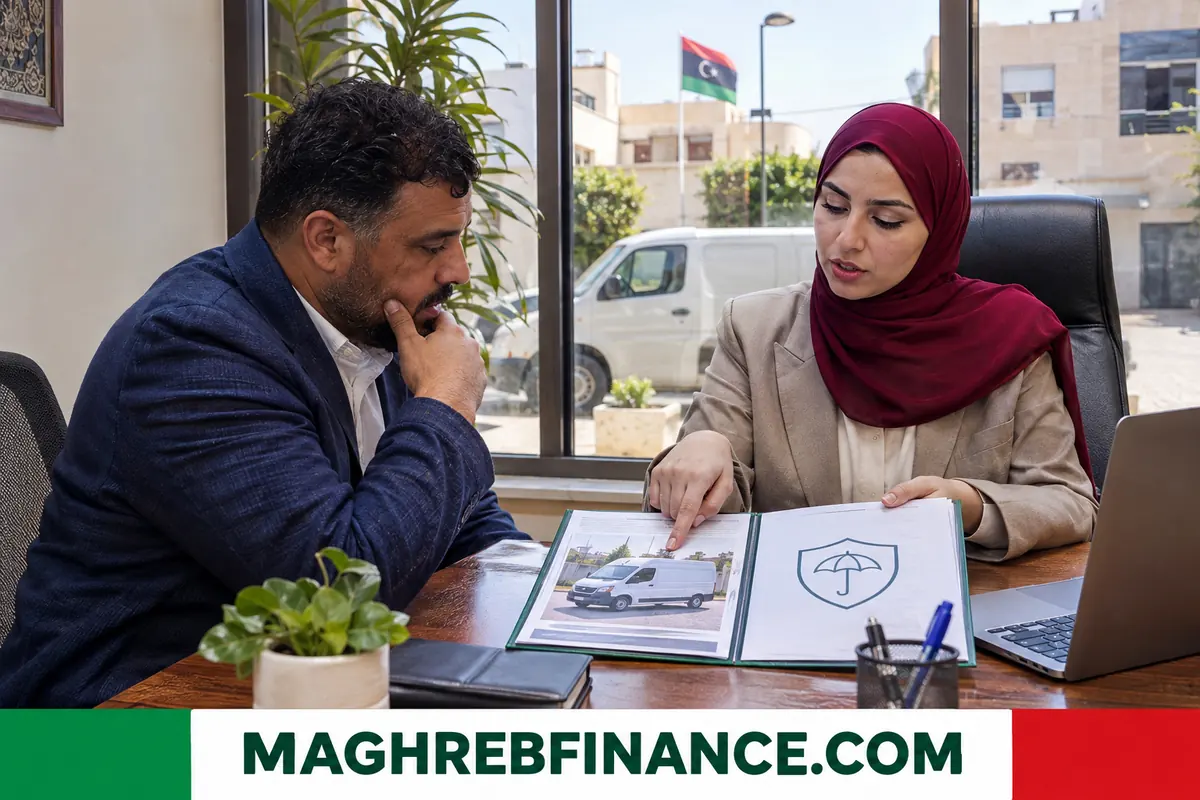
In Libya, takaful is a participative Islamic system in which members fund family and property insurance by contributing to a shared pool that pays claims. Because Libyan law bans interest and many customers want sharia-compliant products, interest in takaful has grown, although the market remains small and the supervising authority and sharia boards matter greatly. Contributions and benefits are expressed in Libyan dinars (LYD), and each operator publishes its own rules on fees, surplus and governance. Compare operators before joining.
How takaful works
Participants pay contributions into a pool and agree to help one another if a loss occurs. The operator manages the fund as an agent or a partner, and charges a fee or shares in profit according to the model.
The contract separates the participants' fund from the operator's own money, which is the main structural difference from a conventional company.
Contributions are usually lower for younger and healthier participants, and the contract may allow the operator to adjust them at fixed intervals if claims rise. Ask how adjustment works and whether you will be informed in advance.
Sharia boards may also decide how the operator treats unclaimed benefits and funds from unknown beneficiaries.
Ask also whether claims are paid from the fund or advanced by the operator, and how long payment normally takes after the documents are complete.
Family takaful
Family takaful pays benefits on death or disability and can include savings elements, education funds or funeral costs. Contributions are divided between a risk part and an investment or savings part where applicable.
Ask how much of each payment reaches the participant's account and how the account may be withdrawn.
Some takaful products link savings to approved investments, such as sharia-screened funds or real asset financing. These investments can lose value, so participants should not assume guaranteed returns.
Participants should ask whether the operator publishes annual reports on the fund, because transparency is a sign of sound management and helps compare operators.
Where a bank sells the policy, ask who is responsible if a problem arises.
Property and general takaful
Property takaful covers houses, shops and contents against fire, water damage and theft, and vehicle takaful covers motor risks. The structure is similar to ordinary property insurance, but the legal basis is mutual help.
Compare the guarantees, the excess and the exclusions just as you would for a conventional policy.
A participant who leaves early may recover only part of the savings element, after deducting costs. Ask for a table showing what you would receive after one, three and five years.
Surplus, deficit and fees
If claims are lower than contributions, the fund has a surplus that may be returned to participants or kept for reserves, depending on the rules. If the fund has a deficit, the operator may offer an interest-free loan to be repaid from future surplus.
Ask for these rules in writing. The sharing method and the operator's fee should be easy to understand.
Compared with a conventional insurer, the operator's role is closer to a manager than an owner of the risk. This distinction affects the way fees, surplus and claims are explained, so ask for a plain summary.
Sharia governance
A sharia board reviews the contract, the investment policy and the claim practice to confirm that they follow Islamic principles. Investments should avoid interest, gambling, alcohol and other prohibited sectors.
A reputable operator names the scholars, publishes decisions and allows participants to ask questions.
Many people hold both takaful and conventional policies because the choice at a given company may be limited. If you do, avoid duplicate cover for the same risk and keep each contract separate.
The Libyan market and supervision
Takaful in Libya is still developing and offers are fewer than in the Gulf. Some conventional insurers and banks run Islamic windows, and the national insurance authority supervises the sector.
Check the licence of the operator and ask where the fund is invested and which bank holds it.
Banks offering Islamic financing may recommend a takaful partner for property or vehicle cover. You are not always obliged to accept it, so compare it with other licensed offers.
Choosing between takaful and conventional cover
Price, claim reputation and service quality matter as much as religious preference. Compare quotations, read exclusions and ask about claim settlement times.
Some participants choose takaful because it matches their beliefs, while others compare only price, and both approaches are legitimate when the terms are clear.
In disputes, the contract should state the rules on arbitration and the governing law. Look for a clause that explains how sharia questions are resolved and which body gives the final opinion.
Claims and rights of participants
Report a loss promptly, keep photographs, receipts and police reports and send the claim form with identity papers. The operator pays from the participants' fund according to the rules.
If you disagree with the decision, use the complaints procedure, then the supervising authority or the competent court.
Education about takaful is still limited. Reputable operators publish clear brochures, answer questions in Arabic and welcome comparison with other products.
Frequently asked questions
Is takaful interest-free?
Yes. The model avoids interest and invests under rules set by a sharia board, though the exact practice differs between operators.
Do participants receive a share of the surplus?
In some models, yes. Others keep the surplus as reserves, so ask for the rule before joining.
Is takaful available for cars and homes?
Some operators and Islamic windows offer it, but choices in Libya are limited compared with conventional insurance.
Who checks that a product is sharia-compliant?
A sharia board, which should be named and independent, reviews the contract and the investments.