
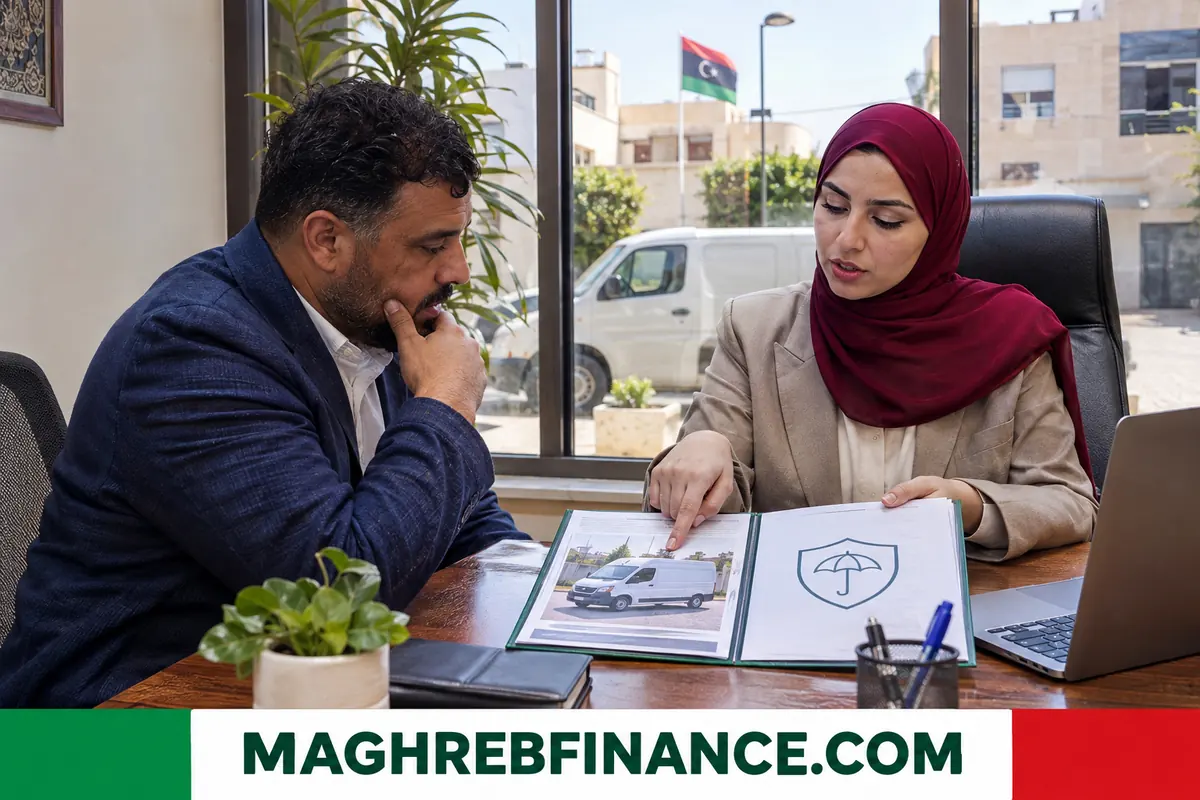
Libya: Ijara wa Iqtina, an Islamic business leasing contract, lets a company use an asset for a fixed period and then become its owner through a promise, gift or sale at the end. The bank buys the machine, vehicle or premises, owns it during the lease and collects lease payments in Libyan dinars (LYD). The Central Bank of Libya supervises the banks offering it, and legislation promoting interest-free banking has pushed institutions towards sharia-compliant structures. Boards of religious scholars normally review the contract wording before products are launched to customers.
Ijara wa Iqtina in Libya: how it works
The company names the asset and the supplier. The bank purchases it, takes the risks that come with ownership and then leases it to the customer for a defined period at a known payment. Because the bank is owner, it carries responsibility for major structural defects and for loss not caused by the user.
At the end of the term, ownership passes to the customer by a separate act, such as a gift or a sale at a nominal or agreed price, rather than by an automatic clause inside the lease.
Delivery of the asset is usually confirmed by a signed receipt. From that date the lease payments start and the customer is responsible for day-to-day use, cleaning and minor upkeep, while major maintenance linked to ownership stays with the bank unless the contract allocates it differently under accepted rules.
Difference from a conventional finance lease
A conventional lease may treat the lessor as a financier whose main interest is the return on funds. Under ijara the bank must truly own the asset, bear the risks of ownership and charge payments only from the time the user receives the asset. Late payment cannot create compounding charges, and any penalty is usually donated to charity.
These principles shape contract drafting. The purchase must be a separate agreement from the lease, and the sale price cannot be fixed in a way that turns the contract into a disguised loan.
Assets that can be financed
- Production machinery, tools and workshop equipment
- Commercial vehicles, vans and trucks
- Medical, laboratory and dental devices
- Office premises, warehouses and clinics
- Generators, solar systems and cold stores
- Boats and other maritime equipment, where the bank accepts the risk
Larger projects, such as a factory building or a hospital wing, may use a variation in which the bank finances construction in stages before the lease begins. This needs extra documents, including plans, contractor quotations and progress certificates, and the lease payments should begin only when the facility is ready.
Conditions and documents
The company usually provides its registration, tax and social security records, financial statements, identity papers and a supplier quotation. The bank may request a guarantee, a deposit or an undertaking by the owners. Because the asset is purchased by the bank, the invoice must be addressed to the bank and the delivery recorded properly.
Business activity must be permissible under sharia, so firms involved in prohibited sectors will not qualify.
Pricing and payments
Lease payments are set by the bank using its cost of funds, the asset price and a margin that it considers fair, so it is wise to compare offers rather than rely on the statement that a product is Islamic. Ask for a clear schedule showing the lease payment, maintenance, insurance and the price or method for transferring ownership.
Fixed lease payments give certainty, whereas variable lease payments linked to a benchmark may change during the term. The contract should state which applies.
Compare at least two banks and ask each for the effective total, not just the monthly lease payment. The same equipment can look cheaper under one structure and more expensive under another once insurance, fees and the final transfer price are included.
Risks and responsibilities
The user must keep the asset in good condition, use it only for the agreed purpose and not damage it. Insurance, preferably takaful where available, should cover the asset throughout the term. If the user stops paying, the bank may recover the asset after due process.
Delays in delivery are more complicated in Islamic contracts, since payments normally starts only once the asset is available, so the schedule must be monitored from the first day.
Governance and verification
Check that the bank has a sharia board, ask for the approval of the specific product and request a copy of the standard contract. Reputable providers will explain the structure and answer questions about every clause.
If your own scholar or adviser has doubts, resolve them before signing. Keeping the sharia approval documents with the contract helps later if disagreements arise.
A lawyer familiar with Libyan banking practice can confirm that the contract is enforceable and that the ownership transfer will be recorded properly in the vehicle registry, land registry or other register that applies to the asset.
Frequently asked questions
Is Ijara wa Iqtina the same as leasing with purchase option?
They are similar in effect, but the structure differs. In ijara the bank owns the asset and ownership transfers through a separate act at the end.
Can a non-Muslim company use it?
Yes. Islamic products are open to any customer who meets the conditions, as long as the activity is permissible under the product's rules.
Are penalties for late payment allowed?
Compounding charges are not permitted. A late-payment amount, where charged, is normally directed to charity rather than kept as income.
Who pays for insurance?
The contract states this. Often the bank arranges cover and recovers the cost from the customer through the lease payments or a separate charge.
Does the bank guarantee approval?
No. Approval depends on the company's finances, the asset, security and the bank's own policies.