
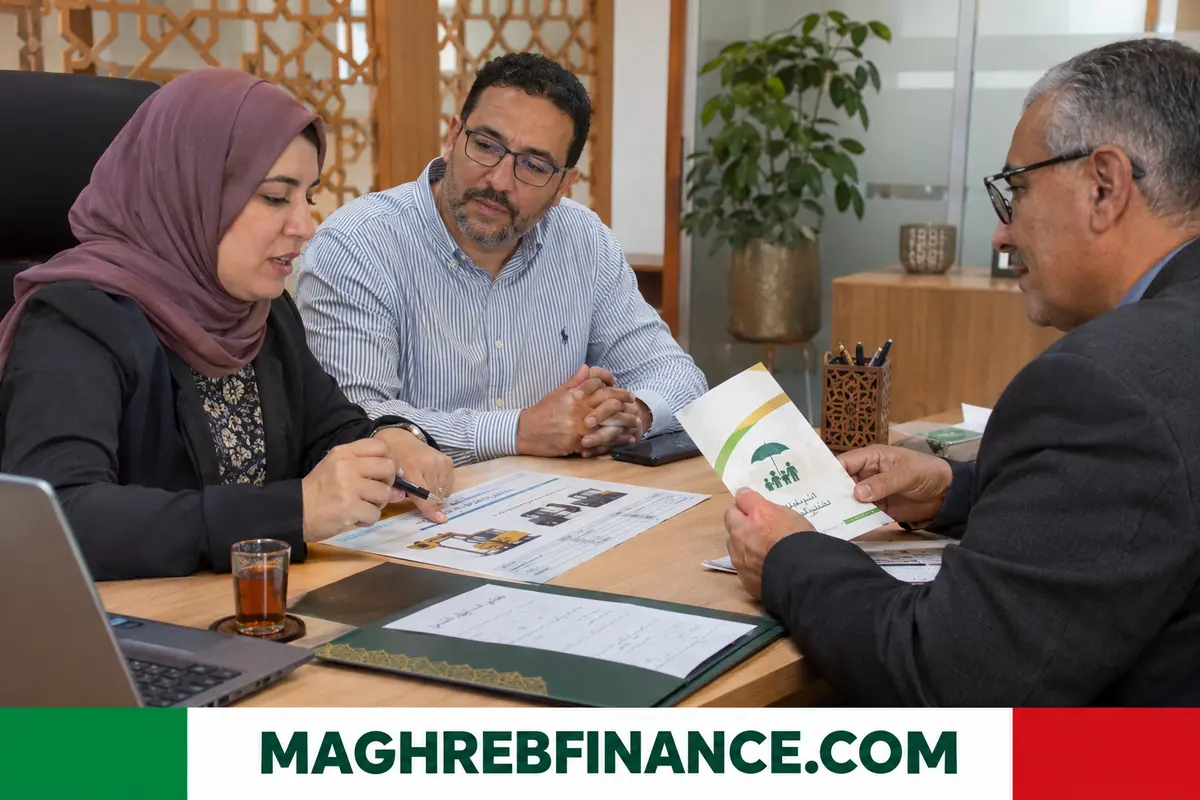
Morocco allows its participative banks to offer murabaha for property, vehicle and equipment purchases as a form of personal financing. The bank buys the item the customer has chosen, becomes its owner, then resells it with a profit margin agreed in advance, payable in instalments in dirhams. The contract rests on a sale, not on an interest-bearing loan. These products are approved by the Sharia Board of the Higher Council of Ulema and supervised by Bank Al-Maghrib, which reassures customers who want financing without interest.
A sale with a known margin
In a murabaha the customer names the asset: an apartment, a car, furniture or a piece of equipment. The bank purchases it from the seller, takes ownership, then resells it to the customer at a price increased by a margin set beforehand. The total price is fixed on signature and paid by instalments.
This mechanism separates murabaha from a classic loan: the bank does not lend money for interest, it sells an asset at a declared profit. Once fixed, the price does not move even if payment stretches out. The flip side is that the customer does not benefit from a later fall in market rates unless the contract is renegotiated or settled early under its own rules.
Legal framework and religious approval
Participative finance developed in Morocco once the banking law authorized it and a supervisory framework was put in place. Products need the binding opinion of the Sharia Board, attached to the Higher Council of Ulema, and banks must follow its compliance standards.
Some institutions are dedicated participative banks, such as Bank Assafa, while others work through a participative window of a conventional bank, such as Arreda. Customers should confirm that the institution is licensed and that the contract mentions the approval. General terms must be handed over before anything is signed.
Property purchase
For a home, the bank buys from the seller or the developer and resells to the customer. The contract states the resale price, the duration and the repayment schedule. Ownership passes to the customer, often with security over the property until the last payment.
Features to know
- the resale price is fixed and not indexed to a rate;
- tax provisions aim to prevent double taxation on the two transfers;
- the home must be identified before financing is agreed;
- notary fees come on top of the price.
As with a mortgage, plan a down payment, insurance, which may be conventional or takaful, and registration costs.
Vehicle purchase
For a car, the bank buys from the dealer and resells at a margin. The vehicle is registered in the customer's name while the bank holds security until the final payment. Motor insurance is compulsory and the bank may require comprehensive cover.
The customer supplies the dealer's pro forma invoice, the purchase order and the usual proof of income. Terms tend to be shorter than for housing because a car loses value faster. Selling before the end of the contract needs the bank's consent, which lifts its security once the balance is paid.
Equipment purchase
Equipment financing covers furniture, household appliances or tools for a self-employed worker. The route is the same: a supplier quotation, purchase by the bank, resale with a margin and staged payment. For an individual this replaces tied consumer credit without interest.
Check the supplier's warranty, which benefits the customer once ownership transfers, and read the delivery terms, since the bank does not deliver the goods itself. Late or faulty delivery should be reported quickly to both bank and supplier so the payment calendar can be adjusted.
Margin, total cost and comparison
The margin is a percentage of the purchase price, fixed at signature. To compare with a loan, calculate the total cost, meaning the resale price minus the purchase price, spread over the duration. Banks give an equivalent rate as a reference, although it is not interest.
Cost can be higher or lower than a conventional loan depending on the market and the term. For late payment the contract may provide penalties, which participative finance often directs to charity. Read this clause with care.
Conditions, documents and risks
Conditions resemble those of ordinary credit: stable income, reasonable debt level, a possible down payment, identity papers and proof of earnings. The customer signs a promise to buy, which the bank carries out by acquiring the asset.
The main risks are skipping a comparison between offers, because the margin presentation can hide the true cost, and committing to a long term with no safety buffer. Beware of intermediaries who claim to offer halal funding without a licence: only an authorized institution can sell these products to the public.
A couple in Rabat chooses murabaha
A couple in Rabat who prefer interest-free finance want to buy an apartment. They compare a participative offer with a conventional loan: resale price, term, monthly payment and file fees. The cost gap turns out to be moderate.
They choose murabaha, have the property identified before signing, check the approval mention and obtain a clear schedule. They keep a safety margin for surprises, since the price is firm and does not fall if market rates drop. Reading the whole contract with the notary spares them nasty surprises.
Frequently asked questions
Is murabaha more expensive than a conventional loan?
Not necessarily. The cost depends on the market, the term and the bank. Compare the total resale price with the full cost of an equivalent loan.
Can the price change during the contract in Morocco?
No. The margin and the price are fixed at signature, a central principle that protects the customer against rising rates.
Who owns the asset while the customer is paying?
The customer becomes the owner at resale, while the bank keeps security. For a home, a mortgage may be registered in the bank's favour.
Can the customer repay early?
Yes, under the contract terms. Some banks reduce the remaining margin, so ask for the exact rule before signing.
Must the customer be Muslim to apply?
No. These products are open to every customer who meets the conditions, whether drawn by religious compliance or by price transparency.