
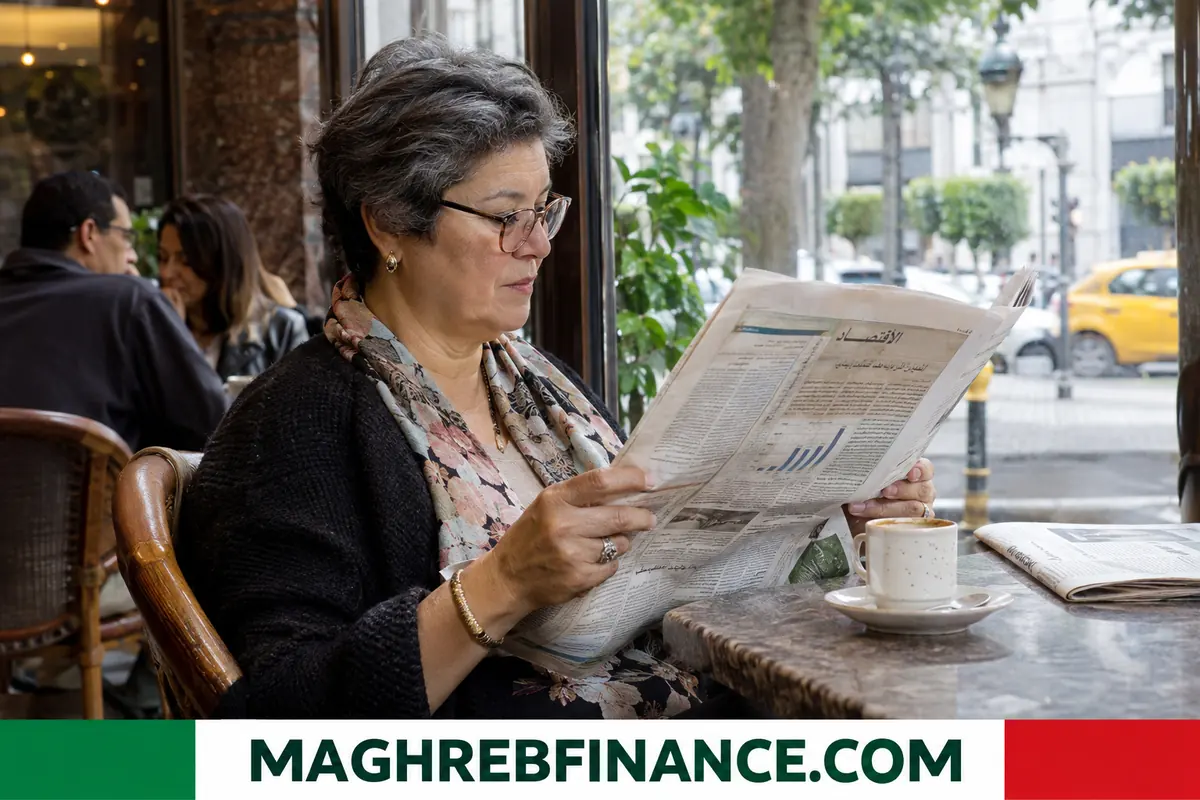
In Tunisia, stock market newspapers gather the publications and sections that relay quotes, equities and bonds and describe the state of the financial markets day by day. They rely on the Tunis Bourse, on notices of the Financial Market Council and on releases from listed companies, with amounts in Tunisian dinars. A saver, a portfolio manager or a business owner spots there the moves of the Tunindex, bond issues and half-year results. These titles turn technical data into readable information.
What the Tunisian market press covers
The Tunisian stock market press is more than a table of numbers. It brings together daily sections on the Tunis Bourse session, stock analyses, reports of general meetings and features on securities issues.
The same subjects return regularly: Tunindex variation, most traded stocks, announced dividends, new listings, capital operations and interest rate trends. General newspapers with an economic focus give a page to them, while specialised financial websites publish several articles per session.
Reading this content means separating factual information, such as a closing price, from an analyst's opinion, which remains an opinion and not a personal recommendation.
How quotes are formed in Tunis
On the Tunis Bourse, stocks are split between a continuous trading segment and a fixing segment, depending on how liquid the security is. The price shown in a newspaper is therefore either the last price traded during the session or a single price set at a given moment.
Prices move within variation limits set by the exchange. A stock can be suspended or reserved up or down when these limits are reached, which newspapers flag with a specific note.
The Tunindex and its version limited to the largest capitalisations serve as a benchmark to measure the general trend of the market.
Equities: reading news on listed companies
For a share, a market newspaper reports the price, the volume traded and, in some cases, the dividend yield. Comments also deal with results published by companies, whether banks, insurers, industrial groups or distributors.
An investor can check each item against official notices issued by the Bourse and the Financial Market Council. Company releases, prospectuses and activity reports supply the original version of the facts that the press summarises.
An article does not replace this cross-checking, since a share can move for technical reasons, such as a dividend detachment, without reflecting a change in the company's situation.
Bonds: government and private issues
The Tunisian bond market groups Treasury bonds issued by the state and bond issues launched by banks, leasing companies or businesses. Newspapers announce the opening of subscriptions, the term, the repayment method and any rating.
These announcements must be read with care: fixed or floating rate, coupon frequency, amortisation of capital and the guarantee of the issue change the nature of the investment. The reference document remains the information note approved by the regulator.
Bond sections also explain the link between the policy rate of the Central Bank of Tunisia, the money market rate and the yield demanded by investors.
Markets and intermediaries: who acts
Buy and sell orders pass through licensed brokerage firms. The Financial Market Council supervises financial disclosure, public offers and the conduct of professionals, while the Bourse organises listing.
Newspapers also mention collective investment schemes, such as open-ended investment companies and mutual funds, which invest in equities or bonds on behalf of savers. Their net asset value is published regularly and picked up by the press.
Understanding this chain of actors shows which body publishes which data and helps judge the reliability of a figure quoted in an article.
Choosing and cross-checking reading sources
A reader gains by combining an economic daily, a responsive financial website and official publications. The first brings context, the second follows the session, the third confirm the figures.
- check the date and time of a price before relying on it;
- distinguish a closing price from an indicative one;
- note the author and the type of article, news or analysis;
- compare several titles on the same event.
A typical session: decoding a report
A session report almost always follows the same plan: Tunindex movement, number of stocks up and down, most active values, then a comment on overall volume. Volume, expressed in dinars, shows whether the move rests on lively trading or a few isolated orders.
- the gap between the general index and the large-cap index;
- the weight of block trades outside the regular session;
- stocks reserved up or down;
- announced operations, such as a capital increase or a dividend detachment.
Comparing several consecutive sessions gives more meaning than one isolated price: a trend is read over time, not over a day.
Useful stock market vocabulary
A few terms recur. Capitalisation is the total value of a listed company's shares. A bond's yield compares annual interest with the purchase price. The coupon is the interest paid periodically, and maturity fixes the date on which capital is repaid.
Nominal value is the face value of a security, liquidity measures how easily one can buy or sell without moving the price, and volatility describes the size of variations. A thinly traded stock can show a price that jumps on very few trades, which newspapers sometimes specify in a note.
Limits and cautions when reading in Tunisia
Market figures age quickly. A price read in the morning has no value the next day, and a rumour repeated without a source is not information. Price forecasts, very common in the financial press, are hypotheses.
Beware also of investment offers boasting guaranteed gains, with no link to a listed security or a licensed intermediary: no return is assured on an equity market.
Frequently asked questions
Which body publishes official prices in Tunisia?
The Tunis Bourse publishes prices and indices from its sessions, and the Financial Market Council issues notices, prospectuses and the official bulletin of operations.
Do market newspapers give buy advice?
Some publish analyses or analyst recommendations, but they remain general. Only a licensed broker can advise an investor on their situation.
Where can bond issue announcements be found?
In the economic press, on issuers' and intermediaries' websites and in information documents approved by the Financial Market Council.
Can the Tunis Bourse be followed online for free?
Yes. Several financial news sites show prices and session news, sometimes with a slight delay compared with the market.
Further reading
- African Manager (English edition) : English-language edition of a Tunisian financial news site, with reports on bond issues, listed companies and the stock market.